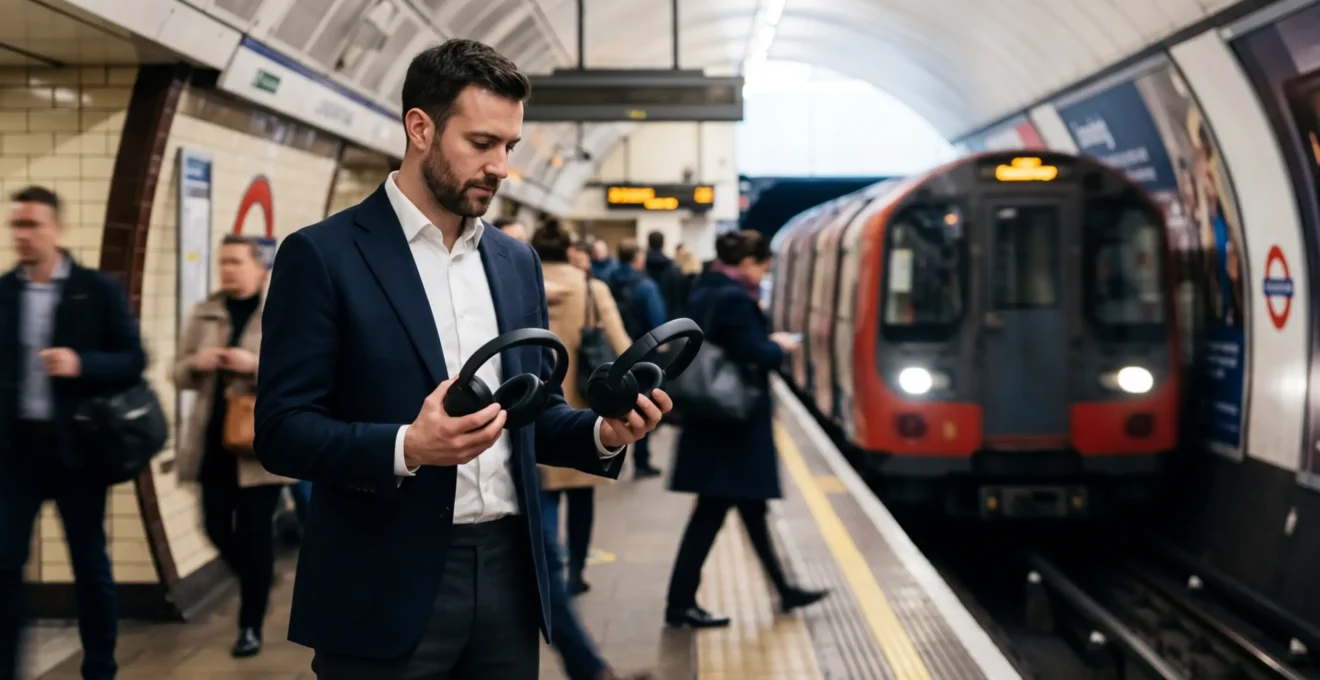
The best headphones for the London Underground are defined not by maximum noise cancellation, but by how intelligently their technology and design conquer the specific acoustic chaos of the commute.
- Sony’s technical prowess in cancelling low-frequency rumbles and its superior battery life offer a distinct advantage for the daily grind.
- Bose counters with unparalleled long-wear comfort and a more compact case, crucial for focus and portability.
Recommendation: For the London commuter prioritising raw silencing power against Tube noise and less frequent charging, Sony holds a slight edge. For those who value all-day comfort for a hybrid work-and-commute schedule, Bose is an exceptionally strong contender.
The screech of the Northern Line pulling into Bank station. The deep, rattling rumble of the Jubilee Line. The cacophony of a thousand conversations in a single carriage. For any London commuter, this is the daily sonic assault. The default solution has always been a good pair of noise-cancelling headphones, but most reviews are written with the steady drone of an airplane engine in mind. The London Underground is a different beast entirely—an unpredictable symphony of high-frequency squeals, sudden impacts, and low-frequency vibrations that we call acoustic chaos.
This is where a simple feature-list comparison between Sony and Bose falls short. As an audio engineer, I argue that the question isn’t just “which is better?” but “which is better engineered for *this specific environment*?” We must move beyond generic talking points and dissect the technology with a critical eye. This analysis won’t just compare decibel reduction; it will evaluate everything from the speed of the ANC processor in reacting to sudden noises to the practical, real-world design of the charging case when you’re fumbling for it on a crowded platform at Victoria.
Through this commuter-focused lens, we will explore how each brand’s philosophy impacts your hearing safety, your situational awareness on busy streets, your workflow, and even your long-term battery management. By the end, we will crown a true champion not for the quietest room, but for the loudest commute.
This detailed comparison will break down the real-world performance of Sony and Bose across several key areas critical to a London commuter. The following sections will guide you through each aspect to help you make an informed decision based on your daily reality.
Summary: Sony vs Bose for the Ultimate Commute
- Why Listening at 80% Volume Is Destroying Your Hearing Permanently?
- How to Use Transparency Mode to Stay Safe While Running in the City?
- The Charging Case Mistake That Leads to Lost Earbuds
- How to Clean Your Earbuds Without Damaging the Speakers?
- When to Charge: The Habit That Extends Your Battery Lifespan
- Kitchen Table or Spare Room: Which Setup Boosts Focus by 40%?
- The Loneliness Epidemic: Why Working from Home Can Be Dangerous for Men?
- Apple Watch or Garmin: Which Tracker Actually Improves Marathon Times?
Why Listening at 80% Volume Is Destroying Your Hearing Permanently?
The primary reason commuters crank up the volume is to drown out external noise. On the London Underground, where ambient noise can easily exceed 90 decibels (dB), many listeners push their devices to 80% volume or higher simply to hear their podcast or music. This is a dangerous game. Your ears don’t distinguish between the sound you want to hear and the noise you want to block; they just register the total pressure. Effective Active Noise Cancellation (ANC) isn’t just a luxury; it’s a critical health tool. By electronically removing the low-frequency rumble of the Tube, both Sony and Bose allow you to listen at significantly lower, safer volumes without sacrificing clarity. This is paramount when you consider that a global health study suggests more than 1.35 billion young people are at risk of hearing loss due to unsafe listening habits.
Understanding the relationship between volume and safe exposure time is crucial. The figures below illustrate a stark reality: what feels like a normal listening level on a noisy train could be causing permanent damage in minutes.
| Volume Level (dB) | Safe Weekly Exposure | Daily Limit (5 days/week) |
|---|---|---|
| 80 dB | 40 hours | 8 hours |
| 85 dB | 12.5 hours | 2.5 hours |
| 90 dB | 4 hours | 48 minutes |
| 95 dB (80% volume) | 1.25 hours | 15 minutes |
The data is clear: at 95 dB, often the output at 80% volume on many devices, your safe daily listening limit is a mere 15 minutes. A single leg of a commute from Zone 4 to Zone 1 can exceed this. This is where the quality of ANC becomes a health metric. Sony has historically excelled at cancelling the low-frequency rumble, while Bose is renowned for its handling of mid-range frequencies like chatter. For the Tube’s specific mix of noise, both perform admirably, but the goal is always to get your listening volume as close to a safe 70-75 dB as possible.
Action Plan: Your Personal Commute Noise Profile
- Points of contact: List every stage of your commute where noise is a problem (e.g., waiting on the platform, screeching tunnels on the Victoria Line, loud announcements, street traffic walking to the office).
- Collecte: For one week, make a note of when you are forced to increase the volume above 50%. Is it due to a specific sound (screech) or a general roar (rumble)? This inventories your personal “acoustic pain points.”
- Cohérence: Compare your list against the known strengths of each headphone brand. Does your biggest problem (low rumble) align with Sony’s strengths, or is it variable chatter that aligns more with Bose?
- Mémorabilité/émotion: Identify the single most stressful noise of your commute. The most memorable moment of relief will come from the headphone that best eliminates *that specific sound*. This is your primary decision driver.
- Plan d’intégration: Based on this audit, you can now test headphones focusing on how they perform against your specific, identified noise profile, rather than relying on generic reviews.
How to Use Transparency Mode to Stay Safe While Running in the City?
A Londoner’s journey doesn’t end at the Tube station. Navigating busy intersections, dodging cyclists, and jogging through crowded parks requires acute situational awareness. This is where a headphone’s Transparency Mode (or Ambient Sound/Aware Mode) becomes a non-negotiable safety feature. It’s no longer about blocking the world out, but intelligently letting it in. The goal is to hear a car horn, a bicycle bell, or a shouted warning without having to remove your headphones and interrupt your audio.
Both Sony and Bose have invested heavily in this technology, but their philosophies differ. Sony often provides more granular control, allowing users to fine-tune the level of ambient sound and even focus on voices. Bose, true to its brand name “QuietComfort,” often aims for the most natural-sounding transparency, reducing the feeling of digital processing. For an urban runner, the key is not just clarity but also cancellation latency—how quickly the headphone can switch from letting sound in to protecting your ears from a sudden, loud noise like a siren. Both brands are leaders, but testing them in a real-world environment is key to discovering which one feels more natural and responsive to you.
The ability to remain aware of your surroundings while still enjoying your audio is a delicate balance, crucial for safety in a dense urban landscape.
As this image illustrates, the modern commuter and athlete needs to exist in a personal audio bubble that is also permeable to essential environmental cues. An effective transparency mode is the technology that makes this possible, turning a potential hazard into a safe and seamless experience. The quality of the microphones and processing algorithms directly impacts how natural and non-fatiguing this experience is over time. A poor transparency mode can sound tinny and artificial, causing more distraction than it prevents.
The Charging Case Mistake That Leads to Lost Earbuds
From an engineering perspective, a product’s design is only as good as its real-world usability. The most common “mistake” leading to lost or damaged headphones isn’t user carelessness; it’s a poorly designed charging case that is too cumbersome for a fast-paced commute. If a case is difficult to open one-handed, too bulky for a pocket, or has a fiddly closure, users are more likely to just stuff their expensive headphones into a bag or pocket, exposing them to damage.
This is a battleground where Sony and Bose have taken starkly different approaches. Bose has historically prioritized portability. For instance, in some head-to-head comparisons, the Bose case folds 40% smaller than Sony’s lay-flat design, a significant advantage for those with limited space in their backpacks. However, portability isn’t the only factor. Ease of use is arguably more critical during the rush hour crush.
This is where expert opinion highlights a crucial design difference. As audio reviewer Mark Ellis notes when comparing the latest models, the physical interaction with the case is a major point of differentiation:
The Sony case wins, simply because of the ingenious magnetic clasp, which makes you wonder why on earth brands like Bose are still opting for fiddly zips.
– Mark Ellis, Mark Ellis Reviews
This single detail is immensely important for a London commuter. A magnetic clasp can be operated quickly with one hand while holding onto a pole on the Tube. A zipper almost always requires two hands and more attention. Therefore, the choice is between Bose’s superior packability and Sony’s superior in-the-moment accessibility. For the sheer chaos of a daily commute, the argument for Sony’s user-centric design is compelling.
How to Clean Your Earbuds Without Damaging the Speakers?
While the title mentions earbuds, the principle is even more critical for over-ear headphones, especially when used on the London transport network. The combination of dust from the tunnels, sweat from a hurried walk to the station, and general urban grime means that regular cleaning is not just a matter of hygiene, but of performance and longevity. Clogged microphone ports can degrade ANC and call quality, while dirty ear cushions can harbour bacteria and deteriorate faster.
The cleaning process for both Sony and Bose headphones is broadly similar, but the key is to be meticulous and use the right materials. Never apply liquids directly to the headphones. The goal is to lift debris away from sensitive components, not push it further in. A soft brush, a microfiber cloth, and a small amount of 70% isopropyl alcohol on the cloth (not on the headphone itself) are your primary tools.
The most delicate part of the operation is cleaning the fabric or mesh grille that protects the speaker driver and the external microphones for ANC.
As this macro view shows, these grilles are intricate. Using a blunt object or excessive force can permanently damage the drivers or microphones underneath. The most effective professional technique is to use a piece of Blu-Tack or museum putty, gently pressing it onto the grille and lifting it away. The putty pulls out dust and debris without applying inward pressure. Following a strict protocol ensures your investment remains in peak condition.
- Remove ear cushions gently, usually with a slight counter-clockwise twist.
- Use Blu-Tack or putty to lift debris from speaker and microphone grilles.
- Lightly dampen a microfiber cloth with 70% isopropyl alcohol to wipe down non-fabric surfaces.
- Clean microphone ports with a dry, soft brush or a dry cotton swab.
- Allow all components to air dry completely for at least 10 minutes before reassembly.
When to Charge: The Habit That Extends Your Battery Lifespan
For a London commuter, “battery anxiety” is a real concern. Forgetting to charge your headphones can be the difference between a serene journey and an auditory nightmare. While enthusiasts debate the merits of charging from 20% to 80% to maximize battery health, the more practical question for a daily user is simpler: “How many commutes can I get before I *have* to charge?” This is where raw battery endurance becomes a killer feature.
In this arena, Sony has consistently held a notable advantage. While performance varies by model and usage, in controlled testing, Sony’s latest models often achieve around 37 hours of playback, whereas Bose’s counterparts clock in closer to 27 hours with ANC on. A 10-hour difference is not trivial; it represents several days of commuting. This means a Sony user might only need to think about charging their headphones once every two weeks, while a Bose user is on a weekly or 10-day cycle. It reduces the mental load, which is a tangible benefit.
To put this in perspective, let’s translate those battery stats into a practical, commute-based charging schedule. This simplifies the decision-making process down to your personal travel time.
| Daily Commute | Sony Charge Cycle | Bose QC Ultra Charge Cycle |
|---|---|---|
| 2 hours/day | Every 18 days | Every 13 days |
| 3 hours/day | Every 12 days | Every 9 days |
| 4 hours/day | Every 9 days | Every 7 days |
The data clearly shows that Sony’s superior battery life translates directly into a more forgiving ownership experience. For a busy professional, having to manage one less weekly task—charging headphones—is a genuine quality-of-life improvement. This practical advantage in power management makes a strong case for Sony in the context of a relentless commuting schedule.
Kitchen Table or Spare Room: Which Setup Boosts Focus by 40%?
The commute is over, but the need for silence often continues. In the era of hybrid work, headphones are no longer just for travel; they are essential tools for deep focus in a domestic environment that might be a quiet spare room or a chaotic kitchen table. The question then becomes: which headphone creates the best “focus bubble” for hours on end?
This is where the debate shifts from raw ANC power to the crucial, and often overlooked, factor of long-wear comfort. A headphone can have the best noise cancellation in the world, but if it causes pressure points or makes your ears hot after an hour, its effectiveness as a focus tool is zero. In this domain, Bose has built its entire brand, and for good reason. Expert reviewers consistently praise their design. As the team at SoundGuys puts it:
Bose wins the comfort round hands down. Their name isn’t just branding — the QuietComfort Ultras really are ultra-comfortable. They have ample, plush padding and a spacious earcup design that’s easy to wear for hours, even on long flights.
– SoundGuys Review Team, SoundGuys Comparison Review
However, comfort is only half the equation. The other half is the effectiveness of the ANC against typical household noises—the spin cycle of a washing machine, a partner’s video call, or traffic outside the window. Here, objective measurements show Sony with a slight technical edge. In controlled tests, Sony’s ANC can achieve an 87% loudness reduction on average, compared to 85% for Bose. While this 2% difference is barely perceptible, Sony’s known strength in cancelling low-frequency sounds gives it an advantage against things like construction or traffic rumble. So, the choice is a trade-off: Bose’s superior all-day comfort versus Sony’s marginal edge in absolute noise-blocking power.
Key Takeaways
- The best commuter headphone is defined by its ability to handle the *acoustic chaos* of the Tube, not just a steady drone.
- ANC is a health tool, allowing you to listen at safer volumes and protecting your hearing from long-term damage.
- Real-world design details like a one-handed magnetic case (Sony) can be more valuable than a slightly smaller, zipped case (Bose) during a hectic commute.
The Loneliness Epidemic: Why Working from Home Can Be Dangerous for Men?
While the title points to a specific demographic and issue, the underlying technological theme is universal: the double-edged sword of total immersion. Creating a perfect, silent bubble with ANC can be a productivity superpower, but it can also lead to social and environmental isolation. This isn’t about gender; it’s about the human need for connection. When you’re completely sealed off from the world, you can miss a colleague’s casual question, a partner’s call from the other room, or the sound of a delivery at the door. This can create a new kind of stress and a feeling of being disconnected, even in a busy household.
From an audio engineering standpoint, the solution isn’t to abandon ANC, but to use headphones with intelligent features that manage the boundary between your bubble and the real world. This is where features like Sony’s “Speak-to-Chat,” which automatically pauses music and enables ambient sound when you start talking, show their value. Bose has similar features, often tied to quick-tap controls. The brand that provides the most seamless and least intrusive way to transition between full immersion and social interaction offers a healthier long-term experience.
Furthermore, if you find yourself wearing headphones all day to combat the silence of working from home, it’s vital to do so responsibly. The goal is to feel connected, not to replace one form of isolation with hearing damage. To that end, experts agree that the 70 dB recommended for all-day listening by organisations like the NIOSH-CDC is a safe upper limit. Both Sony and Bose apps allow you to monitor your listening habits, which is a crucial tool for long-term health.
Ultimately, the most advanced headphone isn’t the one that blocks the world out most completely, but the one that gives you the most control over what you let in.
Apple Watch or Garmin: Which Tracker Actually Improves Marathon Times?
The modern Londoner’s life is an ecosystem of devices. The journey from a morning run tracked on a Garmin or Apple Watch, to a commute listening to a podcast, to a workday on a laptop must be seamless. The role of the headphone in this chain is to be a reliable, high-quality audio link that switches effortlessly between these different contexts. The key technology that enables this is Bluetooth multipoint.
Fortunately, this is one area where the rivalry between Sony and Bose has led to a win for consumers. Both brands’ flagship models now offer robust multipoint connectivity, allowing them to be simultaneously paired to two devices—typically a phone and a laptop, or a phone and a smartwatch. This means you can be listening to music from your phone, and when a notification or pace alert comes from your watch, the headphones will intelligently handle the audio switching. According to technical reviews, both support multipoint for 2 devices simultaneously, making them equally competent for the multi-device user.
However, for the audiophile runner, there are subtle differences. Sony’s support for the LDAC codec allows for higher-resolution audio streaming from a compatible source (like many Android phones), which can offer a richer sound experience. Bose often uses the aptX Adaptive codec, which is prized for its low latency—a potential advantage for ensuring audio cues from a watch are perfectly in sync. To get the most out of this synergy, a specific setup protocol is recommended:
- Enable multipoint on the headphones before pairing with both your phone and watch.
- On your watch, set audio cues for running to a “ducking” mode, which lowers the music volume for the cue rather than pausing it.
- In your phone’s Bluetooth settings, ensure the highest quality codec (LDAC for Sony, aptX for Bose) is selected for your headphones.
- Before race day, do a test run that mimics your arm swing to check for any connection dropouts between the watch and headphones.
- Create a custom EQ profile in your headphone app that slightly boosts the mid-range to ensure pace alerts and voice cues are crystal clear over your music.
The choice between Sony and Bose is less about which is “best” and more about which is best-engineered for your specific life. By analysing your commute, your work style, and your comfort priorities, you can move beyond marketing and make a true engineering-led decision. Evaluate your needs based on this guide and invest in the silence that works for you.