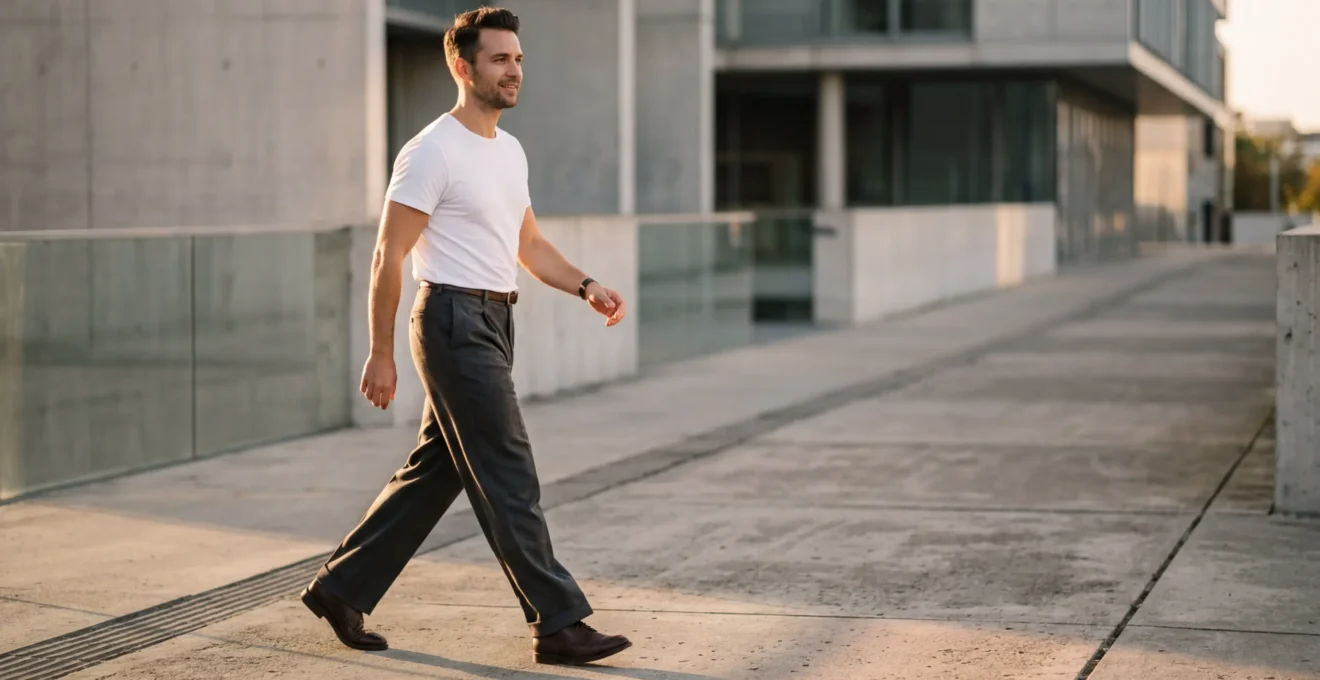
The secret to pulling off wide-leg trousers isn’t about your body type; it’s about mastering fabric drape and creating an intentional silhouette.
- Focus on how a fabric falls and moves with you, not just what it’s made of.
- Create a ‘proportional anchor’ with a tucked-in knit or a well-defined waist-length jacket.
Recommendation: Start by integrating one new pair with three tops you already own to build confidence from your existing wardrobe.
For over a decade, the skinny jean has reigned supreme in men’s fashion, a reliable default for any occasion. But the tide has turned, and a more relaxed, voluminous silhouette is now defining the modern wardrobe. Enter the wide-leg trouser: a style that promises comfort and a sophisticated, architectural look. For the man accustomed to a slim fit, however, this trend can feel less like a liberation and more like a high-wire act without a net. The fear is palpable: will I look like a clown? A teenager from the 90s? Or simply like I’ve borrowed my father’s trousers?
The standard advice—”just pair it with a fitted top”—is a common platitude that barely scratches the surface. It’s a starting point, but it doesn’t explain the ‘why’ behind the ‘how’. It fails to address the nuances of fabric, the subtleties of proportion, or the all-important factor of personal confidence. This approach often leads to a look that feels more like a costume than an authentic expression of style, leaving you more self-conscious than when you started.
But what if the real key wasn’t in following a rigid set of rules, but in understanding a few core principles? The truth is that mastering the wide-leg trend has less to do with your body shape and more to do with the intentional interplay of fabric and proportion. It’s about learning to see the way a material drapes, how a jacket can create a focal point, and how the right details can signal that your choice is deliberate and confident.
This guide will move beyond the basics. We’ll explore why some fabrics set you up for success while others fail, how to choose outerwear that complements—rather than competes with—volume, and how to build a look from the ground up that feels both contemporary and completely natural to you. We’ll even delve into the final, invisible layer of style that makes any outfit work: the confidence to own it.
In the following sections, we will deconstruct the wide-leg silhouette, offering a strategic approach to adopting this pivotal trend. You will learn to think like a stylist, making informed choices that turn a potentially intimidating garment into a powerful staple of your wardrobe.
Summary: A Strategic Guide to Adopting the Wide-Leg Trouser
- Why Fast Fashion Polyester Is Making You Sweat More Than Cotton?
- Trench Coat or Puffer: Which Jacket Will Still Be Cool in 5 Years?
- Mustard or Burgundy: Which Autumn Colour Suits Pale Skin Best?
- The Instagram Trend That Look Good in Photos but Fails in Real Life
- When to Buy Winter Coats: The January Sales vs October Launch Dilemma
- Why You Wear Only 20% of Your Wardrobe (And How to Fix It)?
- Merino or Cashmere: Which Layer Regulates Body Heat Better?
- How to Find Your Signature Scent That Lasts All Day?
Why Fast Fashion Polyester Is Making You Sweat More Than Cotton?
The first step in choosing a successful pair of wide-leg trousers has nothing to do with colour or cut, and everything to do with fabric. Specifically, its ability to breathe and drape. Many fast-fashion options rely on cheap polyester, a material notorious for its poor performance in both areas. From a comfort perspective, polyester fibres don’t absorb moisture; they trap it. This means that while wearing them, you’re not just sweating more—you’re feeling it more. Research consistently shows that people wearing polyester blends experience higher body temperatures and sweat rates compared to those wearing natural fibres like cotton.
Beyond the physical discomfort, this material choice directly sabotages the very aesthetic you’re trying to achieve. The appeal of a wide-leg trouser lies in its graceful movement and the elegant silhouette it creates. This is a function of fabric drape—the way a material hangs and flows under its own weight. Stiff, cheap polyester refuses to cooperate. It creates rigid, unflattering tent-like shapes and holds awkward creases rather than falling smoothly.
Conversely, natural fibres like cotton, wool, and Tencel possess the weight and fluidity needed for a successful drape. They move with you, creating a dynamic silhouette that looks intentional and sophisticated. Before you even consider the fit, perform a simple drape test: hold the fabric, let it fall, walk in it. If it feels stiff and lifeless in your hands, it will look stiff and lifeless on your body, regardless of how perfect the fit is. Choosing a natural, breathable fabric is the foundational decision that makes all subsequent styling choices possible.
Trench Coat or Puffer: Which Jacket Will Still Be Cool in 5 Years?
Once you’ve secured trousers in a beautifully draping fabric, the next challenge is proportion. Wide trousers add volume to the bottom half of your body; the key is to balance this with a deliberate choice for your top half. This is where your outerwear becomes a crucial styling tool. The debate between a timeless trench coat and a trendy puffer jacket isn’t just about warmth—it’s a masterclass in silhouette management.
The puffer, while practical, often adds bulk, creating a continuous, shapeless column from shoulder to ankle. When paired with wide-leg pants, this can result in the very “drowned in fabric” look that many men fear. It’s a primarily casual, trend-cyclical piece that can quickly feel dated. The trench coat, however, operates on a different level. Its design, largely unchanged for over a century, is built around one key feature: a belt. This allows you to create a defined waistline, a proportional anchor that gives structure to the entire outfit. By cinching the waist, you create a clear separation between your torso and legs, which visually balances the volume of the trousers and creates a more flattering, V-shaped upper body.
As the editors at Vogue note, a trench coat is an investment in longevity. As this detailed trench coat versus puffer analysis shows, its versatility is unmatched.
| Factor | Trench Coat | Puffer Jacket |
|---|---|---|
| Design Longevity | 100+ years unchanged | Trend-cyclical (3-5 year peaks) |
| Versatility | Works with formal & casual | Primarily casual/sporty |
| Silhouette with Wide Pants | Defined waist creates balance | Can create shapeless column |
| Investment Value | Classic piece, timeless appeal | Seasonal trend piece |
The trench is a piece of sartorial architecture, designed to enhance form. The puffer is a piece of insulation. For a look that will feel as stylish in five years as it does today, the choice is clear. The trench coat isn’t just a jacket; it’s the most reliable tool for mastering the proportions of the wide-leg silhouette.
A trench coat is a staple that should be with you for a lifetime so, in most cases, it’s worth the investment into a beautifully made design that will last the test of time.
– Vogue Scandinavia Editors, Vogue Scandinavia – Best Trench Coats Guide
Mustard or Burgundy: Which Autumn Colour Suits Pale Skin Best?
Experimenting with a new silhouette like wide-leg trousers is a bold step. The savviest way to approach it is by managing variables. If the cut is your experiment, the colour should be your control. Diving headfirst into a challenging silhouette *and* a challenging colour is a recipe for wardrobe anxiety. For men with paler skin tones, autumn colours like mustard can be particularly unforgiving, often washing out the complexion. Burgundy, on the other hand, is a universally flattering jewel tone that adds richness and depth without competing with your skin.
Think of it as a strategic entry point. Starting with a pair of wide-leg trousers in a safe but sophisticated colour like deep burgundy, charcoal, or navy allows you to focus on getting the fit and proportions right. You can build your confidence in the silhouette itself before you start playing with a more adventurous palette. This approach—changing only one major element at a time—is fundamental to successfully integrating any new trend into your personal style.
A tonal outfit, like pairing burgundy trousers with a brown or deep red knit, is a particularly powerful technique. It creates a cohesive, elongated look that feels incredibly intentional and put-together. This signals that you haven’t just thrown on some clothes; you’ve crafted an outfit. Once you are comfortable with the volume and drape of the trousers in a colour you know works, you can then begin to explore more expressive shades. The following plan provides a clear roadmap for this process.
Your Action Plan: Integrating Colour and Silhouette
- Establish a Safe Baseline: Start with wide-leg trousers in core neutrals like navy, charcoal, or stone. These colours are guaranteed to work with your existing wardrobe and any skin tone.
- Introduce Sophisticated Tones: Once comfortable, move to intermediate colours like olive green, camel, or deep burgundy. These warm, rich tones complement most complexions and add a touch of personality.
- Play with Texture: Before jumping to bold colours, experiment with textured fabrics (like corduroy or herringbone) in the same safe colour families. This adds visual interest without adding risk.
- Adhere to the One-Variable Rule: Never change both silhouette and colour at once. If you’re trying wide-leg for the first time, stick to colours you know and trust.
- Plan Your Pairings: Before buying, identify at least three existing tops and one jacket in your closet that will pair perfectly with the new trousers, ensuring they don’t become a wardrobe orphan.
The Instagram Trend That Look Good in Photos but Fails in Real Life
One of the biggest traps when adopting a new trend is the gap between Instagram and reality. On social media, a pair of ultra-wide trousers can look architectural and heroic. A model stands in a carefully curated pose, the fabric frozen in a perfect, gravity-defying state. In real life, however, you have to move. You have to walk, sit down, and climb stairs. This is where many photo-perfect trends fail spectacularly.
The “in-motion” reality of a garment is where fabric drape and proper tailoring show their true worth. A trouser made from stiff, unresponsive material won’t flow when you walk; it will bunch, catch between your legs, or create awkward, stiff shapes. A hem that is perfectly “kissing the floor” in a static photo will drag on the ground, collect dirt, and become a tripping hazard the moment you take a step. What looks good in a picture is not always what works for a life in motion.
Therefore, the fitting room becomes a performance space. You must put the garment through its paces with a series of real-world stress tests. The goal is to see how the fabric behaves dynamically, not how it looks when you’re standing perfectly still. Does it drape gracefully when you sit, or does it pool into a messy heap? Does it flow when you walk, or does it fight your movement? A successful wide-leg trouser shouldn’t just look good; it should feel like a natural extension of your movement, an enhancement to your presence, not a hindrance. If it fails the in-motion test, it’s not a piece of clothing—it’s a prop.
When to Buy Winter Coats: The January Sales vs October Launch Dilemma
Building a confident wardrobe is as much about *when* you buy as it is *what* you buy. This is especially true when balancing timeless investments with new trends. Take the classic dilemma: do you buy a winter coat at full price during the October launches or wait for the January sales? The answer reveals a deeper strategy for integrating pieces like wide-leg trousers.
As retail analysis shows, October launches are for the trend-driven pieces. This is when you’ll find the most exciting, fashion-forward items. Waiting until January for these might mean they’re sold out or only available in limited sizes. The January sales, conversely, are the prime time to acquire investment pieces—like a classic wool overcoat or a high-quality trench—at a significant discount. These are the items whose designs are stable year after year.
The strategic approach is to align your purchasing with this calendar. You buy the trend piece—your wide-leg trousers—early in the season (e.g., October) at full price. This gives you maximum time to wear and enjoy the trend while it’s at its peak relevance. Then, you use the sales season (January) to acquire the high-value, timeless “anchor pieces” that will support your trends for years to come. This two-pronged approach maximizes both style and value. It also connects directly to a psychological principle: confidence. As one fashion psychology expert puts it:
If you’re not confident enough to wear a trend like wide-leg pants at the start of the season, you probably won’t be confident enough to wear them at all.
– Fashion Psychology Expert, The Full Price Confidence Theory
Paying full price is a declaration of intent. It signals a commitment to the style. Waiting for a discount on a trend piece can often mean your confidence in it is already wavering. Save the bargain-hunting for the classics that will form the bedrock of your wardrobe.
Why You Wear Only 20% of Your Wardrobe (And How to Fix It)?
The common phenomenon of wearing only a small fraction of one’s wardrobe—the “80/20 rule”—is rarely about having the wrong clothes. It’s about having “orphan” items: individual pieces bought on a whim without a clear plan for how they’ll integrate with everything else. A pair of wide-leg trousers, if purchased impulsively, is a prime candidate to become such an orphan, destined to hang unworn at the back of the closet.
The fix is to shift your mindset from buying items to building outfits. Before you even consider purchasing a pair of wide-leg trousers, you must mentally (or physically) style them with at least three tops, two pairs of shoes, and one jacket that you already own and love. This simple pre-purchase audit ensures the new item has an immediate family within your existing wardrobe, dramatically increasing the likelihood you’ll actually wear it.
Furthermore, one of the biggest barriers to wearing new or challenging pieces is imperfect fit. Trousers that are an inch too long or a bit too loose in the waist feel “off” and are easily passed over for a more comfortable, reliable option. This is where the transformative power of a good tailor comes in. A modest £20 hem or waist adjustment can be the difference between a wardrobe orphan and a new favourite staple. It’s the small, one-time investment that unlocks the full potential of the garment, customising it to your body and ensuring it feels as good as it looks. By planning its integration and perfecting its fit, you defeat the 80/20 rule and ensure your new trousers become part of the hardworking 20%.
Merino or Cashmere: Which Layer Regulates Body Heat Better?
While the technical differences in heat regulation between merino wool and cashmere are valid points for outdoor enthusiasts, for the man styling wide-leg trousers, this question misses the point. From a style perspective, the most important quality of your knitwear isn’t its thermal property, but its gauge—or thickness. A fine-gauge knit in either merino or cashmere is the single most effective tool for creating that crucial proportional anchor.
The problem with a chunky, heavy-gauge sweater is that it adds bulk. When worn with voluminous trousers, it contributes to an overall shapelessness. A fine-gauge knit, however, is sleek and form-fitting. Its true power is unleashed when it’s tucked into the high waist of your trousers. This simple act does three things simultaneously: it instantly defines your waistline, it elongates the leg line, and it creates a clean, uninterrupted silhouette that is both elegant and modern.
This tucking technique is the sartorial equivalent of a well-placed belt on a trench coat. It provides the visual break needed to balance the lower-body volume. The choice between merino and cashmere then becomes a matter of texture and budget. Merino is a workhorse—durable, smooth, and more affordable. Cashmere is pure luxury—unbeatably soft and with a subtle halo. Both, however, serve the same primary stylistic purpose: to be thin enough to tuck cleanly, creating the silhouette that makes the entire outfit work. Don’t obsess over the fibre; obsess over the tuck.
Key takeaways
- Fabric is foundational: The drape and movement of a fabric like wool or cotton is more important than the brand or price. Test for flow, not just fit.
- Master proportion with an anchor: Balance the volume of wide trousers by defining your waist, either with a tucked-in fine-gauge knit or a belted, waist-length jacket.
- Confidence is the final layer: Your look is only as successful as your belief in it. Every choice, from fabric to fragrance, should build towards an outfit that feels intentional and authentic to you.
How to Find Your Signature Scent That Lasts All Day?
You’ve mastered the fabric, perfected the proportions, and tailored the fit. The physical components of the outfit are flawless. But there’s one final, invisible element that separates a good outfit from a truly great one: intention. And nothing signals intention quite like a signature scent. It’s the ultimate accessory, a detail that demonstrates your look was crafted with purpose, right down to the air around you.
In the context of a challenging trend like wide-leg trousers, fragrance acts as a psychological reinforcement. It’s a quiet declaration of confidence. When you know you smell good, you stand taller and move with more presence. This palpable self-assurance is what allows you to “own” the look and silence any internal or external doubts. It’s the invisible armour that completes the ensemble. As the team at FashionBeans eloquently states, the right mindset is everything.
Wide-leg pants require presence. Shoulders back, relaxed posture — let the drape do the talking. Once you find your balance, you’ll never go back to slim fits again.
– FashionBeans Editorial Team, The Styling Trick That Makes Any Wide-Leg Fit Look Effortless
Choosing a scent that lasts all day involves selecting a quality Eau de Parfum and applying it to pulse points. More importantly, it involves finding a fragrance that aligns with your personal style. A clean, minimalist look with linen trousers might call for a fresh citrus or aquatic scent, while a more vintage-inspired, pleated wool pair could be enhanced by a warm, woody or leather-based fragrance. The scent doesn’t just complement the outfit; it completes the story you’re telling.
Now that you understand the principles of fabric, proportion, and confidence, the next step is to begin consciously building these elements into your wardrobe. Start by auditing your existing clothes to find your first “proportional anchor” and plan your first integrated outfit.
Frequent questions on How to Wear Wide-Leg Trousers Without Feeling Like You’re in a Costume
How does fragrance relate to pulling off wide-leg pants?
Wearing a deliberate signature scent signals confidence and intention, reinforcing that your bold outfit choice was purposeful rather than accidental.
Which fragrance families match different wide-leg styles?
Clean minimalist looks pair with fresh citrus scents, while vintage-inspired wide-leg styles work with woody or leather fragrances.
Does scent really impact outfit confidence?
The psychological boost from wearing a fragrance you love directly translates to the confidence needed to wear challenging trends like wide-leg pants.