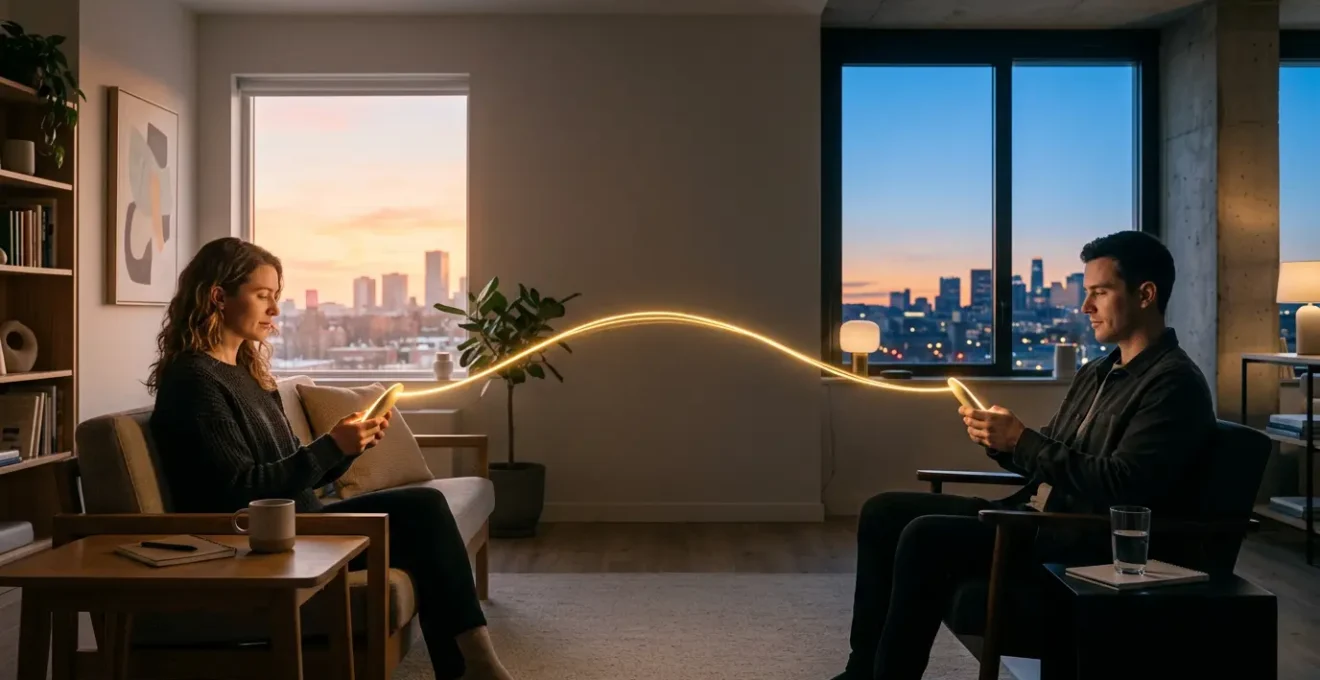
The success of a long-distance relationship doesn’t depend on having more apps, but on using technology with greater intention.
- Effective digital communication relies on setting clear boundaries and expectations to reduce anxiety.
- True intimacy is built by choosing the right tech for specific moments, from secure sharing to creating a sense of “presence.”
Recommendation: Shift your focus from the frequency of communication to the quality of your connection by implementing one new digital boundary this week.
The glow of a phone screen is the modern campfire for the long-distance couple. It’s the window, the bridge, and sometimes, the entire world you share. We’re told the solution to geographical distance is a technological one: just FaceTime more, text constantly, and fill the void with a relentless stream of digital updates. Yet, for many, this constant connection paradoxically leads to more anxiety, misinterpretation, and a feeling of being perpetually on-call rather than genuinely close.
This isn’t another list of apps to download. The internet is already saturated with recommendations for shared calendars and movie-syncing plugins. The common advice often misses the point. The challenge isn’t a lack of tools, but a lack of strategy. If the constant buzzing, the ambiguous “seen,” and the pressure to perform on video calls feel more like a chore than a connection, you’re not alone. The problem isn’t the tech itself; it’s that no one ever taught us how to use it with intention.
What if the key wasn’t about closing the distance with more technology, but by cultivating a higher quality of ‘digital presence’? This guide moves beyond the obvious to explore the psychology of digital communication. We will focus on building a framework of intentional tech use, establishing healthy communication hygiene, and understanding how to use digital tools not just to talk, but to truly be together, apart. It’s time to make technology work for your relationship, not the other way around.
This article provides a complete roadmap, from navigating virtual dates to establishing digital sanctuaries. Discover how to choose the right platforms for the right conversations and, most importantly, how to build a resilient, trust-filled connection that thrives on quality, not just quantity, of interaction.
In this guide: A strategic approach to digital intimacy
- Zoom Dinner or Netflix Party: Which Virtual Date Feels Less Awkward?
- How to Share Intimate Photos Without Risking a Leak?
- Video Call Before Meeting: Genius Filter or Romance Killer?
- The ‘Read Receipt’ Mistake That Causes Paranoia
- When to Put the Phone Away: No-Tech Zones for Couples
- WhatsApp or Instagram: Where Should You Move the Conversation Next?
- Focus Mode or Do Not Disturb: Which Actually Stops the Scrolling?
- How to Write a Tinder Bio That Gets Matches Without Trying Too Hard?
Zoom Dinner or Netflix Party: Which Virtual Date Feels Less Awkward?
The virtual date has become a cornerstone of modern long-distance relationships, but not all digital dates are created equal. The choice between an “active” date like a Zoom dinner versus a “passive” one like a Netflix Party often boils down to one crucial element: the quality of digital presence it facilitates. A Zoom dinner demands active conversation and engagement, mimicking a real-life date, but can feel performative if one partner is tired or distracted. A Netflix Party, while seemingly less intimate, creates a comfortable, shared experience where the pressure is off. You’re together, enjoying the same media, with chat as an optional layer. The key is to match the date to your collective energy levels.
To avoid the awkwardness, the goal should be to create a shared environment. This goes beyond just being on the same call. Consider ordering the same takeaway, lighting matching candles, or mixing the same cocktail. These tangible, sensory links transform a simple video call into a multi-sensory shared experience. The real magic happens when you move from merely observing each other through a screen to participating in a shared ritual. Below are some applications designed specifically to facilitate these shared digital moments.
As the image suggests, the power of a virtual date lies in creating symmetry and a shared atmosphere. The focus shifts from the technology to the romantic ritual itself. The most successful virtual dates are those that use tech to build a bridge for a real-world feeling of connection, rather than letting the tech be the focus. The best choice is often a mix: use active dates to connect deeply and passive dates to simply enjoy each other’s company without the pressure to perform. This intentional variety keeps the spark alive and acknowledges that intimacy has many forms.
Your Action Plan: Essential Apps for Better Virtual Dates
- Rave: Go beyond just movies. Use Rave to sync Netflix, YouTube, and even listen to music together in real-time, all while chatting via text or voice.
- Kast: For the cinephiles, Kast offers perfect frame-by-frame sync for movies and TV shows, eliminating the dreaded “3… 2… 1… Play!” timing issues.
- Discord: Expand your date nights by using Discord’s powerful screen sharing to stream anything from your browser, play a game, or virtually walk through a Google Street View of a place you want to visit.
- Cupla: Eliminate scheduling headaches. Use a shared calendar app like Cupla that features automatic time zone conversion to find the perfect date time without the mental math.
- Marco Polo: For couples with clashing schedules, embrace asynchronous intimacy. Use Marco Polo to send video messages that your partner can watch and reply to whenever they’re free, keeping the connection alive across time zones.
How to Share Intimate Photos Without Risking a Leak?
Intimacy in a long-distance relationship often navigates digital channels, and sharing personal photos can be a powerful way to maintain a close, physical connection. However, the valid fear of leaks, hacks, or digital permanence can turn an act of trust into a source of anxiety. The solution lies in establishing strong communication hygiene and choosing technology built with privacy at its core. This isn’t just about sexting; it’s about creating a private, secure bubble where you can both feel safe to be vulnerable, whether you’re sharing a silly selfie from bed or a more intimate moment.
The first step is a conversation, not a download. Discuss boundaries and consent explicitly. What are you both comfortable with? What happens to the photos after they’re viewed? Agreeing on a secure platform is the second critical step. Mainstream social media apps are not designed for this kind of privacy. You need a tool with default end-to-end encryption (E2EE), which ensures that only you and your partner can see the content. Anything less is an unacceptable risk. In fact, security experts confirm that some apps offer far more robust protection than others, making your choice of platform a crucial decision for digital safety.
The following table compares key privacy features of popular messaging apps. It’s a vital tool for making an informed decision about where you build your private digital space.
| App | End-to-End Encryption | Disappearing Messages | Screenshot Protection | Metadata Collection |
|---|---|---|---|---|
| Signal | Default for all | Yes | Yes (Android) | Minimal |
| Default | Yes | No | Some metadata to Meta | |
| Telegram | Secret Chats only | Yes | No | Regular chats stored |
As the data shows, an app like Signal is widely regarded as the gold standard. Its commitment to default encryption, disappearing messages, and minimal data collection makes it the clearest choice for sensitive communication. Choosing such a platform is an act of care for both yourself and your partner, transforming a potentially anxious act into a secure and trusting expression of intimacy.
Video Call Before Meeting: Genius Filter or Romance Killer?
The pre-date video call has become a standard vetting process in modern dating, but its role within an established long-distance relationship is more nuanced. Is it a vital lifeline or does it slowly kill the romance by replacing mystery with mundane, pixelated check-ins? The answer depends entirely on the mindset you bring to the call. If it becomes a routine obligation—a box to tick—it can indeed feel like a chore. However, when viewed as an opportunity for genuine connection, it can be a powerful tool for intimacy.
The “romance killer” argument often stems from the pressure to be “on” — to perform, to look good, to have interesting things to say. This can feel exhausting. As Elizabeth Green of StarLeaf Digital Age Research notes, “Video calls have revolutionized long-distance communication. Apps like Skype, Zoom, and FaceTime allow couples to see each other’s expressions, share special moments, and virtually be together.” The key is in that last phrase: “virtually be together.” This doesn’t always mean a face-to-face conversation. It can mean having your partner on a call while you both cook, read, or work. This creates a low-pressure sense of shared space and ambient togetherness.
Counterintuitively, technology-mediated communication doesn’t necessarily diminish relationship quality. In fact, it can enhance it. A landmark study from Queen’s University’s psychology department found that individuals in LDRs often reported equal or even higher levels of intimacy, satisfaction, and communication compared to geographically close couples. The necessity of being intentional with communication forces couples to develop stronger emotional bonds. The video call isn’t the filter; the intention you bring to it is. It’s a tool, and its power to build or diminish romance lies entirely in how you wield it.
The ‘Read Receipt’ Mistake That Causes Paranoia
Two blue ticks. “Seen.” The three bouncing dots that suddenly stop. In the quiet of a long-distance relationship, these tiny digital cues can bloom into full-blown paranoia. The “read receipt” is perhaps the single most potent source of anxiety in modern communication. It creates an implicit demand for an immediate response, and when one isn’t forthcoming, our minds race to fill the void with worst-case scenarios. This is the ultimate failure of communication hygiene, where a feature designed for confirmation becomes a tool for insecurity.
The irony is that consistent communication is a cornerstone of a healthy LDR. Indeed, research demonstrates that frequent and responsive texting is linked with higher relationship satisfaction. The problem isn’t the texting; it’s the web of unspoken expectations woven around it. Does a “read” message mean they’re ignoring you, or just that they’re driving, in a meeting, or simply gathering their thoughts? Without clear communication *about* your communication, you’re leaving everything up to interpretation—a dangerous game when you can’t see their face or read their body language.
The solution is to defuse the technology by establishing a “communication contract.” This is an explicit conversation about what digital signals mean to each of you. Do you both agree to turn off read receipts entirely, freeing yourselves from the tyranny of the blue tick? Do you establish that a message read during work hours might not get a reply until later? Setting these ground rules isn’t about being rigid; it’s about being kind. It replaces anxiety-inducing ambiguity with a foundation of trust and understanding, allowing you to focus on the content of your messages, not the timing of the reply.
When to Put the Phone Away: No-Tech Zones for Couples
In a relationship mediated by screens, the most intimate act can sometimes be turning them off. The concept of “no-tech zones” or scheduled digital detoxes is crucial for preventing your connection from becoming entirely dependent on a Wi-Fi signal. While technology is the bridge, the relationship itself must be built on something more substantial than just constant digital availability. It’s about creating space for other forms of connection to grow, ensuring that when you are together, you’re truly present.
Case Study: The Power of Analog Connection
Research highlights a powerful trend: LDR couples who deliberately schedule tech-free activities often report stronger and more resilient emotional bonds. The simple act of stepping away from the screen together reinforces the relationship in a different dimension. Activities like writing and mailing physical letters, co-creating a shared playlist to be listened to separately, or reading the same book in parallel and discussing it later, all help maintain a profound connection without screen dependency. These analog touchpoints become highly anticipated, meaningful events that lead to more significant and cherished reunions.
Establishing these “digital sanctuaries” can take many forms. It could be a rule: no phones during virtual dinner dates. It could be a shared activity: both partners agree to put their phones in another room for an hour each evening to read, meditate, or pursue a personal hobby. The goal is to reclaim individual autonomy and prove to yourselves that your connection exists beyond the digital realm. This practice builds trust and reduces the pressure of feeling like you must be “on” and available 24/7. It’s a declaration that your relationship is strong enough to withstand silence and distance, even digital distance.
This may feel counter-intuitive, but it’s a strategy that works, contributing to the surprisingly high success rates of these relationships. In a world of digital overload, remember that statistics show that about 60% of long-distance relationships ultimately succeed. A key part of that success is learning to balance connection with independence, and a huge part of that is knowing when to put the phone down.
WhatsApp or Instagram: Where Should You Move the Conversation Next?
The journey from a public profile to a private conversation is a key transition in any relationship. For LDRs, choosing the right platform for that transition is a strategic decision. The question “WhatsApp or Instagram?” isn’t just about which app to open; it’s about defining the nature and privacy of your communication. One is a utility for conversation, the other a stage for sharing life. Understanding the difference is key to healthy digital boundaries.
Instagram, with its DMs, stories, and reels, is a fantastic platform for sharing moments and building a visual narrative of your lives. It’s a low-pressure way to stay updated on each other’s day-to-day world—the coffee they’re drinking, the sunset they’re seeing. However, it’s a space designed for performance and is inherently less private. WhatsApp, on the other hand, is a dedicated communication utility. Its purpose is conversation. With its robust end-to-end encryption and focus on direct messaging, it serves as a more private, intentional space. Moving a conversation to WhatsApp is a digital gesture that says, “I want to create a more direct and private line of communication with you.”
The choice of platform sends a signal about the intended purpose of the communication. A successful LDR often uses multiple platforms for different reasons, leveraging the strengths of each. This table breaks down which platform is best suited for different types of couple communication.
| Platform | Best For | Privacy Level | Key Features |
|---|---|---|---|
| Daily communication | High (E2EE default) | Voice/video calls, status updates | |
| Sharing moments | Medium | Stories, reels, collaborative collections | |
| Signal | Private conversations | Highest | Disappearing messages, minimal metadata |
Ultimately, a healthy digital ecosystem for a couple might involve Instagram for light, public-facing sharing, WhatsApp for daily logistics and consistent chat, and perhaps even Signal for the most private and intimate conversations. It’s not about choosing one over the other, but about using each platform with intention, creating layers of communication that mirror the different facets of a real-life relationship.
Focus Mode or Do Not Disturb: Which Actually Stops the Scrolling?
In the battle for our attention, Do Not Disturb (DND) is a blunt instrument. It’s a fortress wall, blocking everything out. Focus Mode, on the other hand, is a surgical tool. It’s a sophisticated filter that allows you to consciously decide what—and who—gets your attention. For a long-distance couple trying to carve out quality time, understanding this difference is a game-changer. It’s the ultimate expression of Intentional Tech.
Focus Mode is a proactive, surgical tool. Frame the use of a custom Focus Mode as an act of intention—not just to block distractions, but to consciously carve out time for work, self, or the relationship.
– Tech Psychology Research Team, Digital Wellness Institute Study 2025
While DND simply silences notifications, Focus Mode allows you to create customized attention environments. You can design a “Work Mode” that only lets through emails from your boss, a “Reading Mode” that silences everything but your Kindle app, and most importantly, a “Partner Mode” or “Date Mode.” This custom mode can be configured to allow notifications only from your partner’s specific number and messaging apps. It’s a powerful digital declaration that says, “During this time, you are my priority.”
This isn’t about being more available; it’s about being more present when you are available. By scheduling a shared “Focus Mode” time, you create a digital sanctuary where you can connect without the constant pull of other notifications. Sharing your Focus status with your partner can also add a layer of transparency, so they know when you’re busy without having to ask. It replaces the anxiety of an unanswered text with the quiet confidence that you have dedicated, protected time for each other. This proactive management of your digital environment is far more effective at stopping mindless scrolling than simply silencing everything.
Here are some ways to implement this:
- Create a custom ‘Date Mode’ that only allows notifications from your partner.
- Set automatic replies for other contacts explaining you’re in dedicated couple time.
- Schedule your Focus modes to activate automatically during your planned virtual dates.
- Share your Focus schedule with your partner so they know your availability without ambiguity.
- Assign a unique notification sound for your partner so their messages always cut through the noise, even when other notifications are silenced.
Key Takeaways
- Intention Over Volume: A thriving LDR prioritizes the quality and intentionality of digital interactions over the sheer quantity of messages and calls.
- Boundaries Are a Form of Care: Proactively discussing and setting digital boundaries (like on read receipts and response times) is essential for reducing anxiety and building trust.
- The Right Tool for the Right Job: Use different platforms for their strengths—public-facing apps for sharing moments, and encrypted, private apps for deep connection and intimacy.
How to Write a Tinder Bio That Gets Matches Without Trying Too Hard?
This title poses a question for the beginning of a journey, but in a long-distance relationship, you’re already far beyond the initial match. The “bio” that truly matters is no longer a witty 500-character paragraph on a dating app. In an LDR, your bio is written every day through your actions, your reliability, and your follow-through. It’s a living document of your commitment, and it’s what truly keeps the attraction alive across the miles. The challenge isn’t getting a match; it’s proving you’re a good one, day after day.
This context is especially relevant given that an incredible 75% of college students have been in a long-distance relationship, a demographic that grew up on the logic of profile-based attraction. Yet, they quickly learn that a relationship’s substance can’t be sustained by a clever bio. The focus must shift from presentation to presence, from witty lines to consistent action.
In an LDR, follow-through is the ultimate attractive trait. The most compelling ‘bio’ is not a witty text, but the action of sending the care package you promised, booking the flight you discussed.
– Dr. Gregory Guldner, Center for the Study of Long Distance Relationships
Dr. Guldner’s point is the ultimate thesis for succeeding in an LDR. The most attractive quality you can cultivate is dependability. Your partner isn’t swiping on you anymore; they are investing in you. Therefore, “writing your bio” now means: using technology to schedule the flight, sharing the tracking number for the package, and setting up a shared calendar that turns “sometime” into a specific date. Every time you use technology to make a promise concrete, you add a compelling line to your “bio.” This is how you get “matches” in a long-distance relationship—by continuously reinforcing trust and demonstrating that you are who you say you are, even when no one is watching.
Your relationship’s success hinges on this consistent effort. Start today by transforming one “we should” into a “we will” by using the tools at your disposal to schedule, plan, and commit. That is the ultimate way to strengthen your bond.