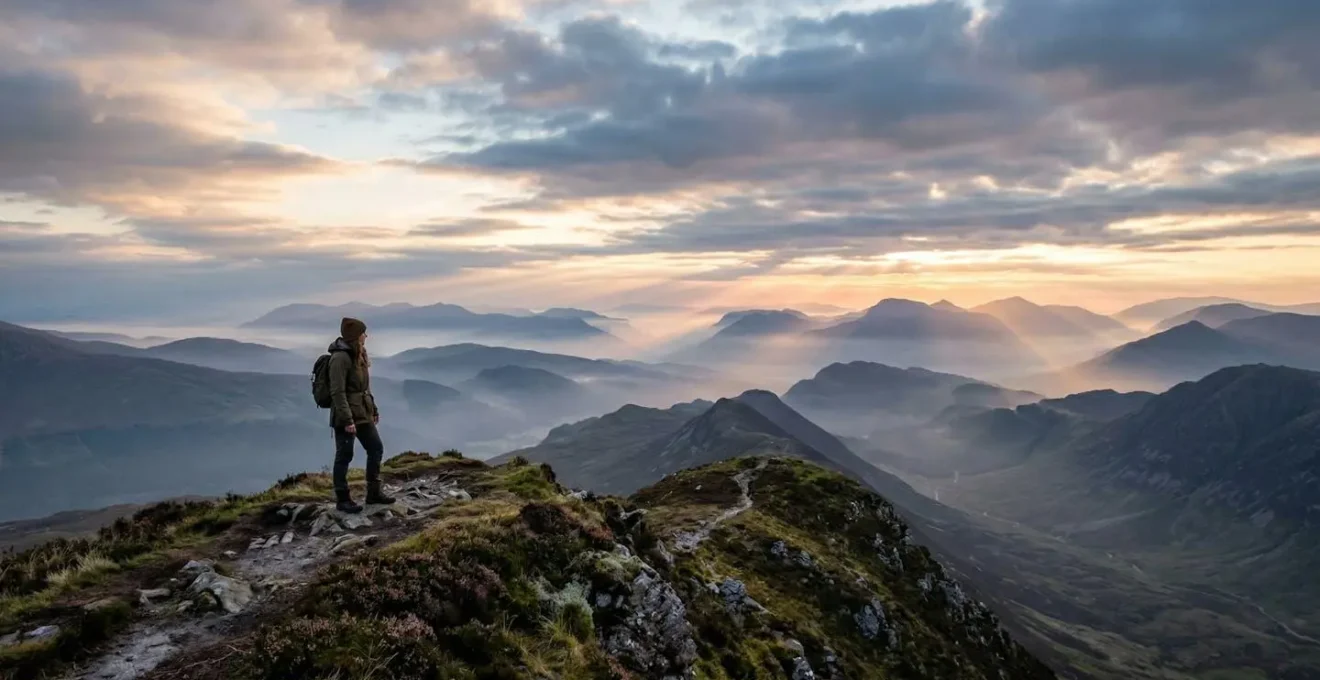
Planning a solo trip to Scotland is not a logistical chore; it’s the first, most crucial step in architecting your mental reset.
- The choices you make before you leave—from destination type to itinerary pace—directly shape the introspective quality of your journey.
- True clarity comes from embracing intentional solitude and depth over breadth, not from ticking off a list of tourist hotspots.
Recommendation: Treat your itinerary as a framework for self-discovery, building in “zero days” and analogue mindfulness practices to turn a vacation into a transformation.
The pressure of the daily grind, the constant digital noise, the feeling that you’re running on a hamster wheel—it’s a familiar state for many urban professionals. The common prescription is to “take a break,” which often translates into a frantic, jam-packed vacation. You might see the famous sights of Scotland, from Edinburgh Castle to the Isle of Skye, but you return just as depleted, your mind still cluttered. The common advice focuses on what to see and where to stay, treating the trip as a simple checklist.
But what if the true power of a solo trip wasn’t in the places you visit, but in the way you design the journey itself? What if the planning process was the first exercise in reclaiming your mental space? This guide isn’t about creating the “perfect” itinerary. It’s about a radical shift in perspective: architecting an experience of intentional solitude. We will explore how to make conscious choices about your environment, your activities, and your pace, transforming your trip from a mere escape into a strategic reset for your mind. It’s about finding clarity not in the roar of a tourist crowd, but in the silence of a Highland glen.
This article provides a structured approach to planning your journey, not as a tourist, but as an architect of your own mindset. Each section tackles a common dilemma, offering a new framework for making choices that serve your ultimate goal: returning home not just rested, but reset.
Summary: The Ultimate Guide to Architecting a Mental Reset in Scotland
- Why Eating Alone in a Restaurant Is the Ultimate Confidence Test?
- Ibiza or The Highlands: Which Destination Actually Helps You Find Clarity?
- Journaling vs Meditating: Which Practice Best Unlocks Self-Discovery?
- The Itinerary Mistake That Turns a Relaxing Trip into a Stress Fest
- When to Switch Your Phone Back On: Reintegrating After a Digital Detox
- South East Asia or South America: Which Is Cheaper for 3 Months?
- Headspace or Calm: Which App Actually Works for Cynical Minds?
- How to Negotiate a Sabbatical from Work to Travel the World?
Why Eating Alone in a Restaurant Is the Ultimate Confidence Test?
The thought of sitting alone at a restaurant table strikes fear into the hearts of many. It’s a public declaration of solitude that we’re conditioned to see as awkward or lonely. But on a trip designed for a mental reset, this act becomes a powerful tool. It’s not about loneliness; it’s about self-reliance and presence. Ordering a meal for one, especially in a warm, traditional Scottish pub, is an exercise in being comfortable in your own skin, without the buffer of conversation or the distraction of a phone.
This isn’t a challenge to be endured, but an experience to be savored. It’s a moment to observe the room, to fully taste your food, to listen to the cadence of the local accent without the pressure to perform or entertain. You are not a passive observer; you are an active participant in your own experience. It’s the ultimate confidence test because it forces you to be your own best company. Passing this test isn’t about bravado; it’s about discovering a quiet, internal validation that doesn’t depend on anyone else. It’s a foundational skill for true self-discovery.
As the image suggests, the focus shifts from the anxiety of being alone to the richness of the sensory experience: the warmth of the whisky, the texture of the aged wood, the low hum of a friendly pub. This is the first step in practicing intentional solitude—transforming what could be a moment of self-consciousness into an act of mindful appreciation and quiet confidence.
Ibiza or The Highlands: Which Destination Actually Helps You Find Clarity?
When seeking a reset, the choice of destination is the most critical architectural decision. It’s a choice between two types of “escape.” A destination like Ibiza offers an externalized, high-stimulation escape—losing yourself in crowds, music, and social energy. A destination like the Scottish Highlands offers the opposite: an internal, low-stimulation environment that forces you to find, not lose, yourself. For a true mental reset, the choice is clear.
The power of the Highlands lies in its “low noise environment.” This isn’t just about audible silence; it’s about a lack of social and digital static. A case study by Wilderness Scotland found that solo travelers in remote Highland locations reported significantly increased mental clarity and decision-making confidence. The landscape itself becomes a tool for introspection. In contrast, the constant stimulation of a party destination requires a recovery period, whereas the clarity gained from solitude in nature has an immediate and lasting effect. The interest in this type of travel is surging; solo trip searches for Scotland jumped from 13% to 46% between 2021 and 2023, signaling a collective desire for more meaningful journeys.
The following table breaks down the fundamental differences in the type of clarity each destination offers, moving beyond surface-level assumptions.
| Aspect | Ibiza | Scottish Highlands |
|---|---|---|
| Type of Clarity | External – through social interaction | Internal – through solitude |
| Noise Level | High social/music stimulation | Natural silence, wildlife sounds |
| Recovery Time | 2-3 days post-trip | Immediate, lasting weeks |
| Cost Factor | High (nightlife, peak season) | Moderate (off-season deals) |
| Solo Traveler Safety | Moderate (nighttime concerns) | Very High (low crime rates) |
Ultimately, the choice isn’t just about location; it’s a strategic decision about the kind of mental environment you want to cultivate. For deep, lasting clarity, the quiet majesty of the Highlands offers a far greater return on investment than the fleeting highs of a crowded beach.
Journaling vs Meditating: Which Practice Best Unlocks Self-Discovery?
Once you’ve chosen the quiet sanctuary of the Highlands, the question becomes how to best use that silence. The two most common tools for introspection are journaling and meditation. Debating which is “better” is a false dichotomy. Journaling is an active, cognitive process of structuring your thoughts, while meditation is a practice of observing them without judgment. The true genius lies in realizing they are not competitors, but partners in a dance of self-discovery, especially when choreographed by the Scottish landscape.
Instead of forcing yourself into a rigid practice, let the environment guide you. The physical act of climbing a Munro can become a walking meditation, your breath and steps falling into a natural rhythm that quiets the mind more effectively than any app. The vast, empty expanse of Rannoch Moor provides a powerful visual metaphor, inviting you to journal about which of your “big” problems suddenly feel small from this new vantage point. The key is to move beyond the abstract and into the practical, using specific locations as triggers for specific introspective techniques.
This approach, which we can call “Landscape-Led Introspection,” turns the entire country into your personal retreat guide. It’s about creating a dynamic dialogue between your inner world and the ancient, powerful outer world of Scotland.
Your Landscape-Led Introspection Plan
- At Callanish Standing Stones: Practice a 10-minute silent meditation. Stand in the center and focus on the feeling of time and the idea of ancestral connection. Don’t try to solve anything; just absorb the sense of history.
- Facing Rannoch Moor: Open your journal. For 20 minutes, write about a problem that feels overwhelming back home. Then, write about how that problem looks and feels from the edge of this vast, empty landscape.
- During a Munro Ascent: Use the physical climb as a walking meditation. Forgo headphones. Focus solely on the rhythm of your breathing and the placement of your feet. Match your breath to your steps. This is about physical presence.
- Beside a Highland Loch: Alternate between practices. For a total of 30 minutes, spend 5 minutes journaling your immediate thoughts, then 5 minutes in silent meditation simply watching the water’s surface. Repeat three times.
- In a Remote Bothy at Night: Create an evening ritual combining both. First, meditate for 10 minutes on the day’s events, sensations, and feelings. Then, immediately open your journal and write down any insights or thoughts that arose during the meditation.
The Itinerary Mistake That Turns a Relaxing Trip into a Stress Fest
The single biggest mistake a solo traveler can make when seeking a mental reset is falling into the “checklist mindset.” It’s the belief that the value of a trip is measured by the number of places seen and photos taken. This approach turns a journey of self-discovery into a stressful logistical race against time, replicating the very pressure you’re trying to escape. Cramming Edinburgh, Glasgow, Skye, and the North Coast 500 into ten days is not a reset; it’s a recipe for exhaustion.
The data backs this up: research shows that solo travelers who try to see too much report 35% lower satisfaction rates. The constant travel, packing, and unpacking creates a state of perpetual motion that prevents deep connection with any single place. The solution is a strategic shift from breadth to depth, a model best described as the “Anchor & Radiate” approach. This involves choosing one or two primary bases—your “anchors”—and exploring the surrounding regions on day trips, or “radiating” out from your base.
Case Study: The ‘Anchor & Radiate’ Success Model
A solo traveler documented their 9-day Scotland trip where they deliberately resisted the urge to “see it all.” They anchored in Edinburgh for 4 days, using it as a base to explore the city deeply and take a day trip to the Borders. They then moved to a single anchor in Inverness for 3 days, from which they explored Loch Ness and parts of the Cairngorms. Crucially, they built in two “Zero Days”—days with absolutely nothing planned. The traveler reported feeling more relaxed and deeply connected to the rhythm of Scotland than friends who had rushed through twice as many locations in the same timeframe. This approach allowed for spontaneous discoveries, like lingering in a pub or taking an unplanned hike, which became the most memorable parts of the trip.
This model is the physical manifestation of mindset architecture. It prioritizes stillness, spontaneity, and immersion over a frantic tick-box tour. By building empty space into your plan, you give yourself the greatest gift a reset trip can offer: the freedom to listen to your own instincts.
When to Switch Your Phone Back On: Reintegrating After a Digital Detox
The goal of a digital detox in the Highlands isn’t just to be without your phone for a week; it’s to break the cycle of reactive, unconscious consumption of information. The real challenge isn’t switching it off; it’s how you switch it back on. Turning your phone on at the airport and being hit with a tidal wave of notifications, emails, and social media updates can undo all the mental clarity you’ve cultivated in a matter of minutes. The re-entry must be as intentional as the escape.
The key is a phased re-entry. You wouldn’t go from a week of fasting to an all-you-can-eat buffet. The same principle applies to your digital diet. Before you even switch your phone on, take five minutes to write down a “Digital Intention Statement”: what is the role you want this device to play in your life now? What boundaries will protect your newfound mental space? This statement becomes your constitution for the re-entry process. You are no longer a passive user; you are the architect of your digital environment.
The process of reintroduction should be gradual and deliberate, allowing your mind to adjust and enabling you to make conscious choices about what you let back into your mental space. This protocol transforms the act of turning on your phone from a moment of surrender to a final act of empowerment.
- Day 1 Post-Trip (Travel Day): Essential Communications Only. Allow only core functions: maps, airline apps, and messaging apps for essential contact (e.g., letting someone know you’ve landed). Do not open email. Do not open social media. Check for urgent messages once, then put it away.
- Day 2: Reintroduce Personal Utilities. You can now add back non-social, utility-focused apps. This includes your photo library (to review your trip), music or podcast apps, and weather. The goal is to use the phone as a tool, not a source of endless scrolling.
- Day 3: Limited Social Media Reconnaissance. The first re-entry into social media is the most dangerous. Set a timer for 30 minutes. Scroll through your main feed to “catch up.” When the timer goes off, log out. Do not re-engage for the rest of the day.
- Day 4: Structured News & Email Check. Choose one trusted news source and review the headlines for 15 minutes in the morning. For email, do a “triage” pass: delete spam, archive non-urgent items, and respond only to what is absolutely critical. Close the client.
- Day 5 Onwards: Implement Permanent Boundaries. Based on your Digital Intention Statement, implement new, permanent rules. This could include turning off notifications for specific apps, scheduling “email-free” hours, or deleting apps that you realized you didn’t miss at all.
South East Asia or South America: Which Is Cheaper for 3 Months?
For the man contemplating a major life reset, the idea of a 3-month sabbatical in a far-flung, exotic location like South East Asia or South America is tempting. It promises adventure, cultural immersion, and a complete break from the familiar. However, for a *first* solo trip aimed specifically at a mental reset, this can be a strategic error. The logistical complexity and high potential for culture shock can easily overwhelm the introspective purpose of the journey.
While cheaper on a day-to-day basis, these long-haul backpacking trips introduce a host of new stressors: visa runs, currency conversions, significant language barriers, and constantly shifting safety considerations. Your mental energy is spent on adaptation and survival, not on introspection. This is why data shows that over 50% of experienced solo travelers recommend Europe for first solo trips. Scotland, in this context, provides a “proximate otherness”—it’s different enough to feel like an adventure, but familiar enough (in language, customs, and infrastructure) that you can focus your energy inward.
Think of it as the difference between depth and breadth. A 3-month trip across multiple countries is an exercise in breadth, skimming the surface of many cultures. A 2-week, focused trip in Scotland is an exercise in depth, allowing for deep immersion in one culture and, more importantly, in your own thoughts. The return on investment for your mindset is far higher when you minimize external friction. The goal isn’t to prove you can survive; it’s to create the optimal conditions to thrive internally.
Headspace or Calm: Which App Actually Works for Cynical Minds?
In our hyper-optimized world, the default solution for a cluttered mind is a meditation app. The debate often centers on which slick interface or soothing voice is most effective: Headspace or Calm? For the cynical mind, especially one standing in the middle of the Scottish Highlands, this debate is entirely moot. The answer is neither. The most powerful, effective, and authentic app for mindfulness is the environment around you.
A study of solo hikers on the West Highland Way found that those who left their apps behind and relied on natural cues reported deeper and more authentic states of mindfulness. The rhythm of their own walking became a mantra. The ever-changing weather became a lesson in acceptance. The wind whistling through a glen was described as “nature’s white noise machine,” far more effective than any digitally produced soundscape. This is analogue mindfulness—an organic, responsive practice that can’t be replicated by code.
Relying on an app in the middle of such a powerful landscape is like going to a Michelin-star restaurant and eating a protein bar. It misses the point entirely. The real “app” is the connection you build, not just with nature, but with the people who inhabit it. As one solo travel influencer noted:
The first time I visited Scotland solo I went to Glasgow. I chatted with the owner of a coffee shop who was so pleased I had picked his home city to visit, that he refused to let me pay my bill.
– Hannah Rose, Solo Travel Influencer Interview
That moment of human connection delivers a feeling of well-being and belonging that no guided meditation can touch. The cynical mind is often skeptical of prescribed, one-size-fits-all solutions. The beauty of Scotland is that it offers a bespoke mindfulness experience, free of charge. You just have to be willing to put your phone down and open your eyes.
Key takeaways
- Your trip’s success is determined by the “mindset architecture” you design during planning, not just the destinations you visit.
- Embrace “Intentional Solitude” and the “Anchor & Radiate” model for your itinerary to prioritize depth and mental space over a stressful checklist of sights.
- Utilize Scotland’s landscape as your primary tool for “analogue mindfulness” through journaling and walking meditation, which is often more effective than any digital app.
How to Negotiate a Sabbatical from Work to Travel the World?
Perhaps your two-week reset in Scotland was so transformative that it planted a bigger seed: the desire for a longer journey, a true sabbatical. The biggest obstacle isn’t the planning; it’s your job. The idea of asking for three months off can feel like a career-ending move. However, framing this request correctly can turn it from a “vacation” into a strategic investment in your professional value.
Do not present this as a break *from* work, but as a program *for* work. Call it a “Strategic Resilience Break” or “Self-Directed Professional Development.” Your solo journey is not an escape; it’s a field study in self-reliance, cross-cultural communication, creative problem-solving, and decision-making under uncertainty. These are the highly sought-after soft skills that can’t be taught in a corporate seminar. You are not asking for time off; you are proposing a cost-effective way to become a more valuable, resilient, and innovative employee. This is a compelling business case, especially when you consider that research shows that offering flexible time off significantly improves retention, reducing the likelihood of employees quitting by up to 35%.
To successfully negotiate this, you need to present a formal, structured proposal, not a casual request. This demonstrates your seriousness and aligns your personal goals with the company’s interests. The following framework provides a roadmap for building your case.
- Frame as an Investment: Title your proposal “Proposal for a Strategic Resilience Sabbatical.” Avoid words like “vacation,” “break,” or “trip.” Emphasize it as an investment in your professional development.
- Highlight Skill Acquisition: Clearly list the specific, tangible skills you aim to develop. Examples: “enhanced cross-cultural negotiation skills,” “advanced problem-solving in unfamiliar environments,” “mastery of budgeting and resource allocation under dynamic conditions.”
- Propose Measurable Outcomes: Define what you will deliver upon your return. This could be a presentation to your team on “Lessons in Resilience from Solo Travel,” a written report on “Creative Problem-Solving in Low-Resource Settings,” or mentoring a junior team member.
- Suggest Knowledge Transfer: Position yourself as a future resource. Offer to lead a lunch-and-learn session on stress management, adaptability, or a related topic. This shows the company gets a return on their investment that benefits the wider team.
- Offer Flexible Timing & Handover Plan: Show you are a team player. Propose scheduling the sabbatical during a known quiet period for the business. Prepare a detailed handover document and offer to train your temporary replacement, proving you are committed to minimizing disruption.
Now that you have the framework to plan not just a trip, but a transformation, the next logical step is to start building your own “Mindset Architecture.” Begin by applying the “Anchor & Radiate” model to a map of Scotland and see what personal journey begins to emerge.