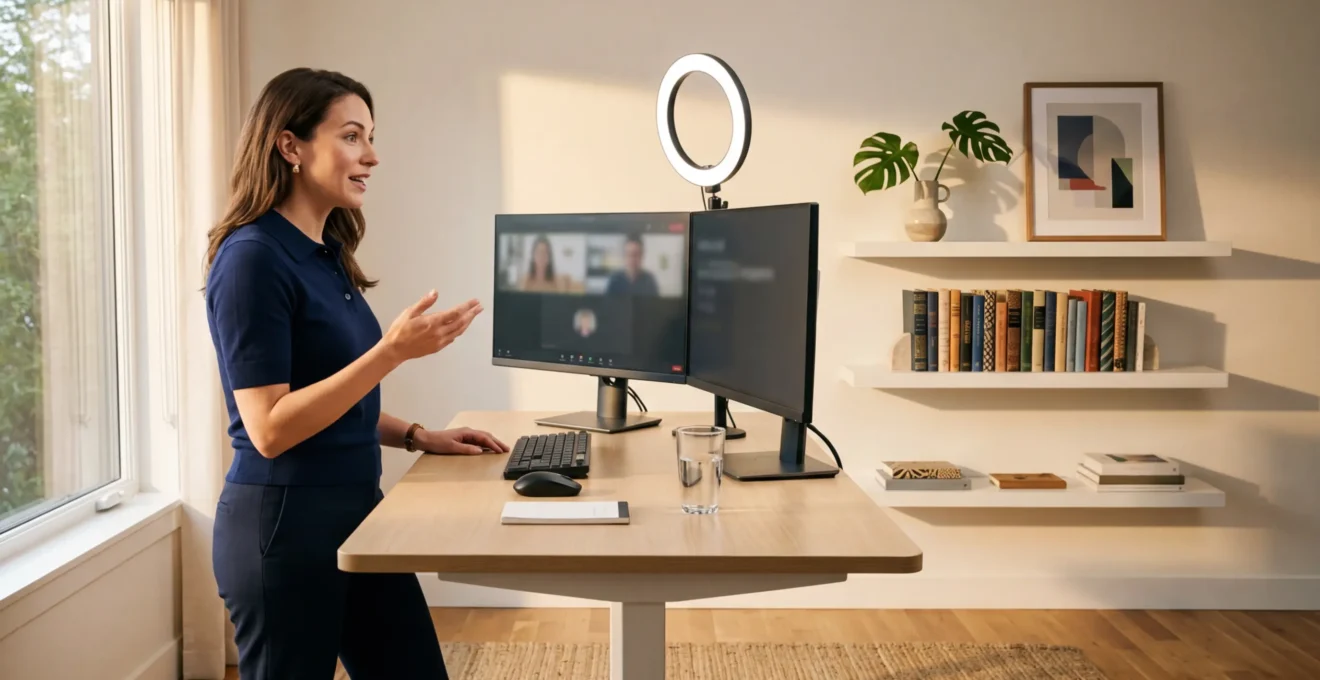
Visibility in a hybrid world isn’t about being ‘always on’; it’s about strategically engineering moments of perceived value.
- Forget constant check-ins. Replace them with high-impact, asynchronous updates that frame your work in terms of business goals.
- Use your office days not just for meetings, but for ‘engineered serendipity’—planned informal encounters with key stakeholders.
Recommendation: Stop trying to be seen more often. Start focusing on making each point of contact—digital or physical—a demonstration of your indispensable value to the team.
The transition to hybrid work has unlocked unprecedented flexibility, but for the ambitious professional, it has also opened a dangerous new front: the battle for visibility. The old rules of being seen—arriving early, staying late, the casual chat by the coffee machine—have been fundamentally broken. Now, a pervasive anxiety settles in for many UK professionals working from home three days a week: “Out of sight, out of mind, out of promotion.”
Conventional advice offers flimsy solutions: “be proactive,” “schedule more check-ins,” “turn your camera on.” This is tactical noise. It treats visibility as a function of frequency, leading to digital presenteeism and burnout. You are left performing availability rather than demonstrating value. This approach is not just ineffective; it’s a career-limiting trap. The real challenge isn’t being seen, but being remembered for the right reasons.
What if the solution wasn’t to shout louder in the digital void, but to play a smarter, more strategic game? The key to managing your career in the hybrid era is to shift your mindset from passive visibility to active, engineered influence. It’s about transforming every interaction, from a Slack message to an office day, into a calculated move that builds your personal brand and showcases your irrefutable value. This is not about working harder; it’s about making your work *work harder for you*. This guide provides the playbook to move beyond mere presence and start building strategic, career-advancing influence.
This article will provide a tactical framework for navigating the new corporate landscape. Read on to discover the strategies that will ensure your contributions are not just seen, but valued, positioning you for the advancement you deserve.
Summary: How to Manage Hybrid Working Visibility
- Kitchen Table or Spare Room: Which Setup Boosts Focus by 40%?
- How to Switch Off Teams Notifications Without inducing Anxiety?
- The ‘Tech Neck’ Symptom That Is Ruining Your Posture
- Hoodie or Shirt: What Is Acceptable on Zoom in 2024?
- When to Go into the Office: Tuesday to Thursday Myths Debunked
- CV or LinkedIn: Which One Do Recruiters Actually Look at First?
- The Burnout Risk of ‘Professionalism’ That No One Talks About
- How to Use Emotional Intelligence to Negotiate a Higher Salary?
Kitchen Table or Spare Room: Which Setup Boosts Focus by 40%?
The debate between the kitchen table and a dedicated office isn’t about comfort; it’s about control. Your workspace is no longer just a desk—it’s the stage upon which your professional performance is judged. While research from Stanford shows that 70% of hybrid workers feel more productive at home, raw output is not the metric for advancement. The critical factor is perceived value, and your environment directly shapes this perception. A chaotic background suggests a chaotic mind; a curated space implies strategic control.
Choosing a spare room over a communal area is the first strategic play. It establishes a physical boundary that reinforces a mental one, signalling to both yourself and others that you are in a zone of deep, professional focus. This isn’t about hiding from family; it’s about creating a controlled environment where you can project authority. The 40% boost isn’t just in your focus; it’s in the perceived focus and professionalism you broadcast on every video call.
Your home office setup is an investment in your personal brand. It must be designed not just for ergonomic comfort but for strategic communication. Every element, from lighting to microphone quality, contributes to your digital body language. A poorly lit frame or crackling audio doesn’t just make you look unprofessional; it makes you seem less competent and less authoritative. You are building a broadcast studio for one, and the quality of the production directly impacts your career trajectory.
Action Plan: The Strategic Home Office
- Position your workspace near natural light to enhance your presence and project energy on video calls.
- Invest in a high-quality external microphone; clear vocal projection is a non-negotiable element of authority.
- Create distinct ‘zones’ within your space: one for deep, focused work, and a separate, optimised setup for client-facing calls.
- Curate your background with intent. Use professional literature, minimalist art, or a clean branded backdrop to reinforce your expertise.
- Incorporate a standing desk option. The ability to stand during key meetings projects dynamism and engagement.
How to Switch Off Teams Notifications Without inducing Anxiety?
The constant ping of notifications is the single greatest threat to your strategic focus. Many professionals, fearing invisibility, chain themselves to their status indicators, believing that instant availability equals value. This is a junior-level mistake. True influence in a hybrid environment is built not through constant low-value chatter, but through high-impact, scheduled interventions. The power move is not to be ‘always on’, but to be strategically ‘off’.
This requires mastering the art of asynchronous influence. Instead of reacting instantly to every query, you must train your colleagues and superiors to value your considered, comprehensive responses delivered on your schedule. Research into digital communication highlights a key insight: successful remote workers replace instant replies with scheduled, high-value asynchronous updates. They proactively show ‘how the sausage is made’ through structured progress reports, demonstrating control and foresight rather than reactive firefighting. This reframes your silence not as absence, but as focused, deep work.
The anxiety of switching off stems from a fear of missed opportunities. To counter this, you must build a system of communication boundaries that is both firm and transparent. Use status messages in Teams or Slack not just to say you’re “busy,” but to state what you’re focused on (“Deep work on Q3 strategy deck—will respond to messages at 2 PM”). This communicates control and purpose. It trains others to respect your time while simultaneously advertising your high-value activities.
The ‘Tech Neck’ Symptom That Is Ruining Your Posture
Your physical posture in a hybrid world has become a direct proxy for your professional presence. ‘Tech neck’—that forward slump of the head from staring down at a laptop—is more than a health concern; it’s a career liability. On a video call, poor posture reads as disinterest, lack of confidence, and low energy. You could be delivering a brilliant analysis, but if you’re a slumped silhouette, the message your boss receives is one of disengagement. Your physical carriage is a constant, non-verbal signal of your authority and engagement.
The ergonomics of your workspace are therefore not a matter of comfort, but of command. Positioning your monitor and camera correctly is a non-negotiable tactic for projecting power. Your monitor must be at eye level, forcing you to maintain an upright, commanding posture. Your external camera should be placed slightly above eye level and angled down, a classic cinematic technique to confer authority. These are not vanity adjustments; they are strategic manipulations of perception that frame you as a leader.
This physical toll of hybrid work is a hidden contributor to burnout. While data from Gallup reveals a 43% higher burnout risk for full-time office workers compared to hybrid models, the insidious physical strain of a poorly configured home setup can negate these benefits. The constant, low-grade physical stress of poor posture drains your energy, reduces your resilience, and ultimately undermines your performance. Investing in an ergonomic chair and taking regular posture breaks are not wellness perks; they are essential performance-enhancing disciplines.
Hoodie or Shirt: What Is Acceptable on Zoom in 2024?
The question of attire in the hybrid era is not about “what is acceptable,” but “what is strategic.” Your wardrobe is a tool of communication. Wearing a hoodie for an internal brainstorming session might be fine, but wearing it for a client pitch or an executive review is a declaration of unseriousness. In 2024, the expectation is not a return to formal suits, but the deployment of a strategic, tiered wardrobe that adapts to the context of the work.
Your clothing choices signal your understanding of the situation’s gravity and your respect for the other participants. A smart professional curates a ‘capsule wardrobe’ for work, with distinct tiers for different types of interactions. This isn’t about fashion; it’s about semiotics. A crisp shirt, even without a tie, communicates preparation and professionalism. A quality knit polo signals a ‘smart casual’ mode, appropriate for internal team meetings. The key is intentionality. Your choice should never look accidental or lazy.
The following framework provides a clear guide for aligning your attire with your professional objectives. Adopting this tiered approach removes daily decision fatigue and ensures your visual presence is always aligned with your career ambitions.
| Work Context | Recommended Attire | Key Pieces | Color Psychology |
|---|---|---|---|
| Deep Work Sessions | Premium Comfort | Quality knitwear, henley shirts | Neutral tones for minimal distraction |
| Internal Team Meetings | Smart Casual | Elevated polo, button-down without tie | Light blue for approachability |
| Client/Executive Calls | Power Attire | Blazer with dress shirt, optional tie | Navy or charcoal for authority |
When to Go into the Office: Tuesday to Thursday Myths Debunked
The “Tuesday to Thursday” office migration has become a widely accepted norm, but the strategic professional does not follow the herd. Going to the office on the busiest days simply to be present is a waste of a valuable asset. The purpose of your office day is not to prove you’re working—it’s to execute high-value plays that are impossible remotely. Your office attendance should be a surgical strike, not a casual commute.
The core tactic is engineered serendipity. This means abandoning the idea of chance encounters and instead, actively planning for “coincidental” high-impact interactions. Before your designated office day, scan the calendars of your boss and key stakeholders. Plan your day around their known movements. Your goal is to create 3-5 brief, informal but strategic touchpoints. This could be a “quick question” in the hallway that you’ve prepared for, a shared coffee break, or walking the same route to a meeting. These moments feel organic to them, but are meticulously planned by you.
To maximize the impact of these days, deploy a pre-and-post communication strategy. Send a preparatory email the day before, announcing your visit and seeding topics you’d like to briefly discuss (“Looking forward to being in tomorrow. If you have a moment, I’d love your 2-minute take on the X project.”). After your office day, send a follow-up email summarizing the informal chats. This extends the visibility of your visit, documents your proactivity, and frames you as a strategic communicator. You are transforming a single day of physical presence into three days of perceived influence.
CV or LinkedIn: Which One Do Recruiters Actually Look at First?
For external roles, recruiters glance at your LinkedIn first. It’s a quick, visual filter. But for the ambitious professional focused on internal progression, this question is a dangerous distraction. The document that senior leaders and promotion committees *actually* look at first is your internal digital footprint. Your profile on Slack or Teams, your history of contributions in shared channels, and your pattern of communication—this is your new corporate CV.
Your internal profile is prime real estate that most professionals neglect. It should be a dynamic summary of your value. Your profile picture must be a professional headshot, consistent with your LinkedIn, projecting a unified brand. Your status should be updated weekly to reflect your current project focus, advertising your contributions (“Focused on Q3 data analysis for Project Phoenix”). Your bio should be populated with your key skills, certifications, and links to recent successful project deliverables. It’s an always-on billboard for your competence.
More importantly, you must master the art of communicating the value you bring to the business. It is not enough to do good work; you must be seen as someone who understands and contributes to business goals. This involves proactive progress reporting that frames your tasks in the language of outcomes. Instead of saying “I’ve finished the report,” you say, “The competitive analysis report is complete; key insight is that we have a 15% market share opportunity in sector Y, which supports our Q4 growth objective.” This demonstrates a C-suite mindset, shifting perception from ‘doer’ to ‘strategist’.
The Burnout Risk of ‘Professionalism’ That No One Talks About
There’s a dangerous, unspoken definition of “professionalism” that is a direct path to burnout in the hybrid world: the belief that one must be ‘always on’ and instantly responsive. This toxic interpretation forces professionals into a state of hyper-vigilance, constantly monitoring emails and messages for fear of appearing unresponsive. This isn’t professionalism; it’s a performance of availability that sacrifices deep work and strategic thinking for shallow reactivity.
While hybrid work can reduce stress—workplace wellness data shows 36% of remote workers report increased stress compared to 59% in-office—this “always-on” pressure creates a unique burnout trap that can erase those benefits. The constant context-switching and low-level anxiety it generates are corrosive, leading to diminished productivity and eventual exhaustion. True professionalism lies in the opposite direction.
As Korn Ferry Advance Leadership Coach Sarah E. Williams astutely observes, it’s about redefining the term for the modern workplace. Her insight provides a powerful new framework:
True professionalism is not about being ‘always on’, but about setting and communicating clear boundaries
– Sarah E. Williams, Korn Ferry Advance Leadership Coach
Embracing this definition is a power move. It signals confidence, self-respect, and strategic control. It demonstrates that you are the master of your time and attention, not a slave to your inbox. Setting and enforcing boundaries—like designated focus blocks and clear response time expectations—is the ultimate display of senior-level professionalism.
Key takeaways
- Visibility is not about frequency; it’s about the perceived impact of each strategic interaction.
- Your digital and physical setup is not about comfort; it is the stage for your professional brand and a tool for projecting authority.
- Mastering asynchronous influence and engineered serendipity are the two core skills for career advancement in a hybrid model.
How to Use Emotional Intelligence to Negotiate a Higher Salary?
A salary negotiation is not an event; it’s the culmination of a year-long campaign. If you walk into your performance review hoping to justify a raise based only on the work you’ve done, you’ve already lost. The negotiation was won or lost in the preceding months through the strategic deployment of your digital emotional intelligence (EQ) and the cultivation of your political quotient (PQ).
Digital EQ is the ability to ‘read the digital room’. It’s about understanding your boss’s communication preferences and adapting your style to maximize impact. Do they prefer a quick Teams message or a structured email? Do they value data-driven reports or narrative-based updates? Successfully navigating this means your messages are not just received, but welcomed. You become an effective, low-friction partner, which is an immensely valuable trait.
Simultaneously, you must be building your PQ. This is the art of understanding and navigating the informal influence networks within your organization. The goal is to become indispensable. You achieve this by proactively mapping influence networks, volunteering for high-visibility cross-functional projects, and, most importantly, anticipating your boss’s pain points and providing unsolicited solutions. When you solve a problem before it’s even fully articulated, you move from being a valuable team member to an essential strategic asset.
By the time you sit down for your review, your manager should already be your advocate. Your consistent demonstration of high digital EQ, your proven track record of making their life easier, and your documented history of indispensable contributions have built an unassailable case for your value. The salary discussion becomes a mere formality, a confirmation of the high-value perception you have spent a year meticulously constructing.
By shifting your focus from performing presence to engineering perceived value, you transform the challenges of hybrid work into your greatest career advantage. Deploy these strategies consistently to ensure that when it comes time for promotions and raises, your name is not just on the list—it’s at the top.