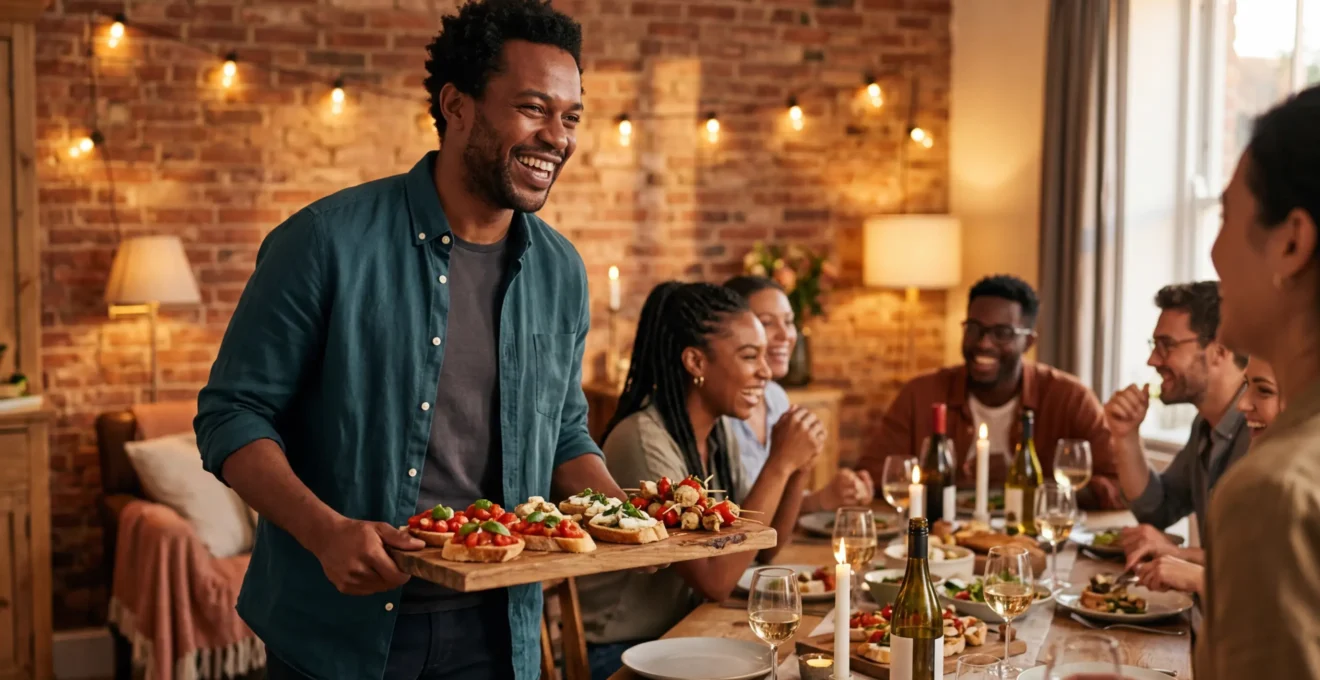
The secret to a great dinner party isn’t avoiding rules; it’s about mastering the new ones that genuinely create connection.
- A smart guest mix, blending old friends with new faces, is more critical than the food you serve.
- Modular menus that allow guests to build their own plates eliminate dietary stress without you cooking two meals.
- The evening’s success hinges on a “musical arc” that guides the energy, not just a random playlist.
Recommendation: Stop trying to be a perfect cook and start acting as a social architect, deliberately designing an atmosphere of effortless connection.
The thought of hosting a dinner party can trigger a specific kind of modern anxiety, especially for men in the UK. There’s a fine line between a warm, memorable evening and a stuffy, try-hard affair that has your friends glancing at their phones under the table. We’ve all been to parties that felt more like a formal inspection than a relaxed gathering, and the fear of recreating that stiffness can be paralysing. The result? We either don’t host at all, or we fall back on the same safe, but ultimately uninspiring, routine.
Common advice often revolves around vague platitudes like “just be yourself” or “don’t overcomplicate the menu.” While well-intentioned, this ignores the tactical realities of modern hosting. How do you cater for a vegan, a carnivore, and a gluten-free friend without turning your kitchen into a frantic short-order diner? How do you curate a vibe that encourages real conversation, not just polite chit-chat over music that’s slightly too loud? These are questions of design, not just of hospitality.
But what if the key to a genuinely relaxed and impressive evening wasn’t in ignoring the details, but in mastering the right ones? The secret to not being pretentious is not a lack of effort, but the application of smart, invisible effort. It’s about shifting your role from a stressed-out cook to a savvy social architect, consciously engineering an atmosphere that feels effortless *to your guests*. This guide provides a new framework for hosting, focusing on the strategic choices that foster genuine connection and make your evening memorable for all the right reasons.
This article will guide you through the essential pillars of modern hosting, transforming your approach from the guest list to the final compliment. Below is a summary of the key areas we will explore to help you master the art of effortless hospitality.
Summary: A New Blueprint for Hosting
- Why Inviting Only Your Closest Friends Is a Hosting Mistake?
- How to Cook for Vegans and Carnivores Without Making Two Meals?
- Supermarket Wine vs Wine Merchant: Where to Find the Best Value Bottles?
- The Playlist Mistake That Kills the Vibe Before Dessert
- When to Clean Up: The Etiquette of Tidying While Guests Are Still There
- How to Network in a London Pub Without Being Salesy?
- Pub or Cocktail Bar: Which Noise Level Is Best for Connection?
- How to Compliment Her Without Sounding Creepy or Generic?
Why Inviting Only Your Closest Friends Is a Hosting Mistake?
The instinct to surround yourself only with your closest, most comfortable friends is understandable. It feels safe. However, it’s the single biggest barrier to a truly dynamic and memorable evening. A group of people who already know each other inside and out has very little conversational fuel. The energy tends to be pleasant but flat, often fizzling out as people retreat into familiar pairings and inside jokes, inadvertently excluding any plus-ones. The goal of a great host, a true social architect, is to create new connections, not just re-affirm existing ones.
This is where the concept of conversational friction comes in. By intentionally mixing your guest list, you introduce new stories, perspectives, and energies. The ideal dinner party size is surprisingly small; research from Michigan State University suggests seven people (plus or minus two) is the sweet spot for fostering meaningful group interaction. Within this group, your job is to curate a mix of ‘Anchors’ (your close friends who ground the atmosphere) and ‘Catalysts’ (newcomers or friends-of-friends who spark new conversations).
This deliberate curation prevents social siloes and forces the group to find common ground, which is the bedrock of a great party. It transforms your role from a mere entertainer to a facilitator of new friendships and experiences. Your friends will leave not just having had a good meal, but having met someone interesting, which is a far more valuable and lasting impression.
Your Action Plan: The ‘Anchor & Catalyst’ Guest Strategy
- Identify Anchors: Designate 30-50% of your guest list as ‘anchor’ guests. These are your close friends who know you well and can help carry the social load.
- Recruit Catalysts: Fill the remaining spots with ‘catalyst’ guests. Think of interesting colleagues, a friend of a friend you’ve always wanted to know better, or a neighbour with a fascinating job.
- Manage Availability: Create a primary and a secondary invite list. This allows you to manage “no” RSVPs without stress, simply moving to the next person on your catalyst list.
- Map Connections: Before the party, ensure every single guest has at least one potential, non-obvious connection point with another attendee, whether it’s a shared hobby, a past travel destination, or a mutual interest.
- Design Prompts: As the host, have a few open-ended questions in your back pocket that can bridge gaps between your guests, reflecting the common threads you’ve already identified.
How to Cook for Vegans and Carnivores Without Making Two Meals?
The modern dinner party is a minefield of dietary requirements. The fear of navigating this has put many a potential host off entirely. The old approach was to either cook a lowest-common-denominator vegan meal that left carnivores unsatisfied, or to cook two completely separate meals, doubling your stress and workload. The modern, non-pretentious solution is to reject this binary choice and adopt a modular menu strategy. It’s about designing a meal as a customisable system rather than a single, rigid dish.
This approach centres around a high-quality, universally appealing base—think a fantastic grain bowl bar (quinoa, freekeh), a taco station with fresh corn tortillas, or a gourmet pasta setup. The base itself is vegan and delicious. The magic happens in the modules: an array of toppings and additions that allow guests to build their own perfect plate. This is not about compromise; it’s about empowerment. The vegan guest feels thoughtfully catered to, not like an afterthought, and the meat-eater can add their grilled lamb skewers or pulled pork without issue.
This elegant solution is detailed in the ‘Modular Menu Success Strategy’ case study, which demonstrates how family-style serving with 2-3 exceptional, universally compatible sauces can tie the whole experience together. This turns the meal into an interactive, conversational centrepiece, taking the pressure off you as the sole provider and making everyone a co-creator of their own culinary experience. It is the epitome of smart, effortless-looking hosting.
As you can see, the visual appeal of a modular spread is part of its charm. It communicates abundance, choice, and care without a single word. Your role shifts from short-order cook to the curator of a beautiful and delicious experience, allowing you to spend more time with your guests and less time sweating over four different pans.
Supermarket Wine vs Wine Merchant: Where to Find the Best Value Bottles?
Choosing the wine is a classic hosting pressure point. The supermarket aisle offers a paralysing paradox of choice, filled with anonymous brands and flashy discount labels. The wine merchant, on the other hand, can feel intimidating, a place where you might be judged for your lack of knowledge. The key to navigating this is to redefine what “best value” means. It’s not about the lowest price or the biggest discount; it’s about the best story. A pretentious host tries to impress with price; a great host impresses with thoughtfulness.
A local wine merchant is your greatest ally here. For the same £15-20 you might spend on a heavily marketed, mass-produced bottle at the supermarket, a merchant can offer you a wine with a narrative. They can tell you about the small family who produced it, the specific region it comes from, and why it pairs perfectly with your menu. This story becomes a gift you give to your guests, a natural conversation starter that makes the wine—and by extension, your party—feel curated and special. It turns a simple beverage into a point of connection.
The following table breaks down the strategic advantages of each source, but the central takeaway is clear: for creating a memorable experience, the personal touch of a wine merchant is almost always the higher-value option.
| Source | Price Range | Story Potential | Best For |
|---|---|---|---|
| Wine Merchant | £15-30 | High – Personal stories from producers | Creating conversation, signature house wines |
| Supermarket | £10-40 | Low – Anonymous brands | Last-minute purchases, familiar labels |
The ‘best value’ bottle is the one with the best story. A £15 wine from a merchant who tells you about the small family that produced it is infinitely more impressive than a £40 anonymous bottle from the supermarket.
– Wine Expert from La Crema, La Crema Hosting Guide
Ultimately, a wine chosen with intention and a good story shows a level of care that money can’t buy. It signals to your guests that you’ve thought about their experience in detail, which is the very essence of great, non-pretentious hosting.
The Playlist Mistake That Kills the Vibe Before Dessert
Music is the invisible architecture of your party’s atmosphere, yet it’s often the most mishandled element. The single biggest mistake hosts make is creating a single, monolithic playlist and leaving it on a loop. The energy required when guests are arriving and mingling is completely different from the energy needed during an intimate dinner conversation, or the relaxed vibe required post-dessert. Treating them the same is like using a hammer for every job in your toolbox. The result is often music that’s too sleepy at the start, too loud during dinner, and too jarring at the end.
A truly skilled host thinks like a DJ, curating a musical arc that evolves with the evening. This doesn’t require complex equipment, just thoughtful planning. The goal is to support the social energy of each phase, not compete with it. Start with something mellow and atmospheric, then transition to more upbeat but conversation-friendly tracks during the main course, and finally, shift to cooler, more soulful selections as the evening winds down. A great rule of thumb is the ’10-Foot Rule’: if you can’t hold a normal conversation with someone 10 feet away, the music is too loud for the dinner phase.
The right music at the right volume should be felt more than it is heard. It’s a subtle tool of atmosphere engineering that makes conversation flow more easily and makes the space feel warmer and more inviting. It’s the difference between a party that feels seamless and one that feels just a little… off.
This image perfectly captures the goal: the focus is on human connection, with the music serving as a warm, textural background rather than the main event. By creating a musical arc, you are subtly guiding your guests through the evening, creating a cohesive and emotionally resonant experience without ever having to say a word.
When to Clean Up: The Etiquette of Tidying While Guests Are Still There
It’s the moment every host dreads: a mountain of dirty plates and glasses piling up in the kitchen. The urge to start washing up can be overwhelming, but giving in to it is a critical hosting error. The clatter of plates and the sight of a host wearing rubber gloves sends a powerful, unspoken signal to your guests: “The party is over.” It immediately shatters the relaxed atmosphere you’ve worked so hard to build, making guests feel like they are now an inconvenience, an obstacle to your return to order.
As a host, your primary responsibility is to your guests, not your dishes. Professional hosts use what is known as the ‘Staging Area’ strategy to manage this conflict. This involves designating a hidden spot—a utility sink, a large plastic tub in a pantry, or even a section of the countertop out of direct sightline—to consolidate all the dirty dishes. The main social space remains clear and inviting, while the mess is contained and dealt with later. This simple act of strategic concealment is a masterclass in maintaining the social illusion of an effortless evening.
The only truly acceptable moment for minor, visible tidying is during a natural transition, such as clearing the main course plates just before serving dessert. It’s a logical reset that feels part of the service, not the beginning of the end. Any other cleaning should be out of sight and out of mind.
Your primary role is Host, not Dishwasher. Any action that pulls your focus away from your guests for more than a minute is a mistake.
– Susan MacTavish Best, The Salon Host’s Guide
This quote from salon host Susan MacTavish Best is the ultimate guiding principle. The moment you prioritise tidiness over presence, you have abdicated your most important role. A few dirty plates are a sign of a successful party; an empty room because everyone felt awkward and left early is a sign of a failed one.
How to Network in a London Pub Without Being Salesy?
While it may seem like a different world, the art of connecting with people in a busy London pub holds the exact principles needed for great dinner party conversation. In both scenarios, the goal is to build rapport without seeming transactional or “salesy.” The key is to shift from a mindset of broadcasting to one of inquiry. The most interesting person in the room is often the most interested person. Applying these “Pub Principles” to your dining room is a game-changer for engineering great conversation.
The first rule is to maintain a 2:1 question-to-statement ratio. Actively listen and ask thoughtful, open-ended follow-up questions. This shows genuine curiosity, which is the most attractive form of charisma. Secondly, as a host, you must create ‘Shared Subjects’. Just as a pub has the football on TV or a quirky beer tap, your home has interesting art, a unique cookbook, or the story-driven wine you selected. Use these as neutral conversational launchpads. Instead of asking “What do you do?”, you can say, “This wine is from a tiny vineyard in Sicily; have you ever travelled in Italy?”
Your most powerful tool as a host is ‘Passing the Conversational Baton’. This is the art of introducing two guests not just by name, but with a connecting thread. “Sarah, you have to talk to Tom. Tom, Sarah was just telling me about her trip to Japan, and I know you’ve been wanting to go.” You’ve just created a mini-conversation with its own momentum, allowing you to move on and connect other guests. For smaller groups, dinner party experts suggest a one-conversation rule for groups of up to 12 people is essential to maintain a single, unified connection rather than fragmented chats.
By applying these strategies, you’re not forcing networking; you’re facilitating natural human connection, which is the hallmark of a truly sophisticated host.
Pub or Cocktail Bar: Which Noise Level Is Best for Connection?
Thinking about the sound of your party in terms of distinct “acoustic styles” is a professional-level hosting move. Just as you wouldn’t wear a tuxedo to the beach, you shouldn’t have one sonic atmosphere for the entire evening. The “Pub vs. Cocktail Bar” analogy provides a perfect framework for understanding how to modulate the auditory environment to facilitate connection at different stages of your dinner party. This is a core tenet of atmosphere engineering.
The “Cocktail Bar” energy is perfect for the arrival phase. As guests arrive, the music can be more upbeat and the volume a little higher. This encourages mingling and allows for multiple, simultaneous conversations. It creates a buzz and a sense of excitement. A standing or mingling space is ideal for this phase, as it promotes movement and interaction. However, maintaining this level during dinner is a disaster. It forces people to shout over the music and each other, killing any chance of intimate, whole-table conversation.
Once guests are seated for dinner, you must shift into “Intimate Pub Mode.” This means the music volume drops significantly, becoming a subtle background texture rather than a focal point. The goal is to create a sonic space where a single, unified conversation can take place comfortably. A round table is the ultimate accelerator of this mode, as it puts everyone in each other’s eyeline. After dinner, you can transition again into a relaxed “Lounge Atmosphere,” where the volume can rise slightly to allow for smaller, breakaway conversations to form naturally.
The following table illustrates how to map these acoustic styles to the phases of your party for maximum social impact.
| Party Phase | Acoustic Style | Volume Level | Table Setup Impact |
|---|---|---|---|
| Guest Arrival | Cocktail Bar Energy | More upbeat, multiple conversations | Standing/mingling space |
| Dinner Service | Intimate Pub Mode | Significantly lower, single conversation | Round table for unified discussion |
| Post-Dinner | Lounge Atmosphere | Medium, allows smaller group chats | Rectangular table creates natural divisions |
Key takeaways
- Engineer Connection, Don’t Force It: Your primary job is to be a social architect. A smart guest list and well-managed conversation flow are more important than a flawless main course.
- The Story is the Value: From the wine you choose to the art on your walls, use objects with a narrative as conversation starters. Thoughtfulness impresses more than expense.
- Control the Arc: A great party has a beginning, a middle, and an end. Guide the energy of the evening through a carefully planned musical and conversational arc.
How to Compliment Her Without Sounding Creepy or Generic?
The final, and perhaps most nuanced, skill in the modern host’s toolkit is the ability to give a genuine, effective compliment. It’s the ultimate act of making a guest feel seen, valued, and welcome. A clumsy, generic, or creepy compliment can undo an entire evening’s worth of goodwill. The key is to move away from comments on physical attributes and towards acknowledging choices, contributions, and character. This is the pinnacle of being a gracious social architect.
A powerful and safe framework is the ‘Observation + Impact’ formula. Instead of a generic “You look nice,” try “That’s a fantastic colour on you (observation), it really brightens up the room (impact).” Even better, focus on their choices: “Your taste in film is incredible (observation), you’ve given me a list of movies I’m now genuinely excited to see (impact).” This makes the compliment about them and their effect on you, rather than just a statement about their appearance. It’s specific, personal, and much more meaningful.
As a host, one of your best opportunities is to compliment a guest’s contribution. “The wine you brought is fantastic, where did you find it?” This not only validates their choice but also opens up a new avenue of conversation. Timing is also crucial. A well-placed compliment when introducing two guests (“You have to meet Jane, she tells the most brilliant stories”) creates an immediate positive association. It’s a functional tool for social lubrication, not just empty flattery. Ultimately, this skill is about generosity—the generous act of noticing something positive in someone and articulating it in a way that makes them feel good. This focus on smaller, more intimate gatherings is backed by data; a study found that 59% of people prefer a dinner party of 4-6 guests, the perfect size for these kinds of meaningful interactions.
Start your journey as a modern host by applying just one of these principles at your next gathering. You will be amazed at the difference it makes.