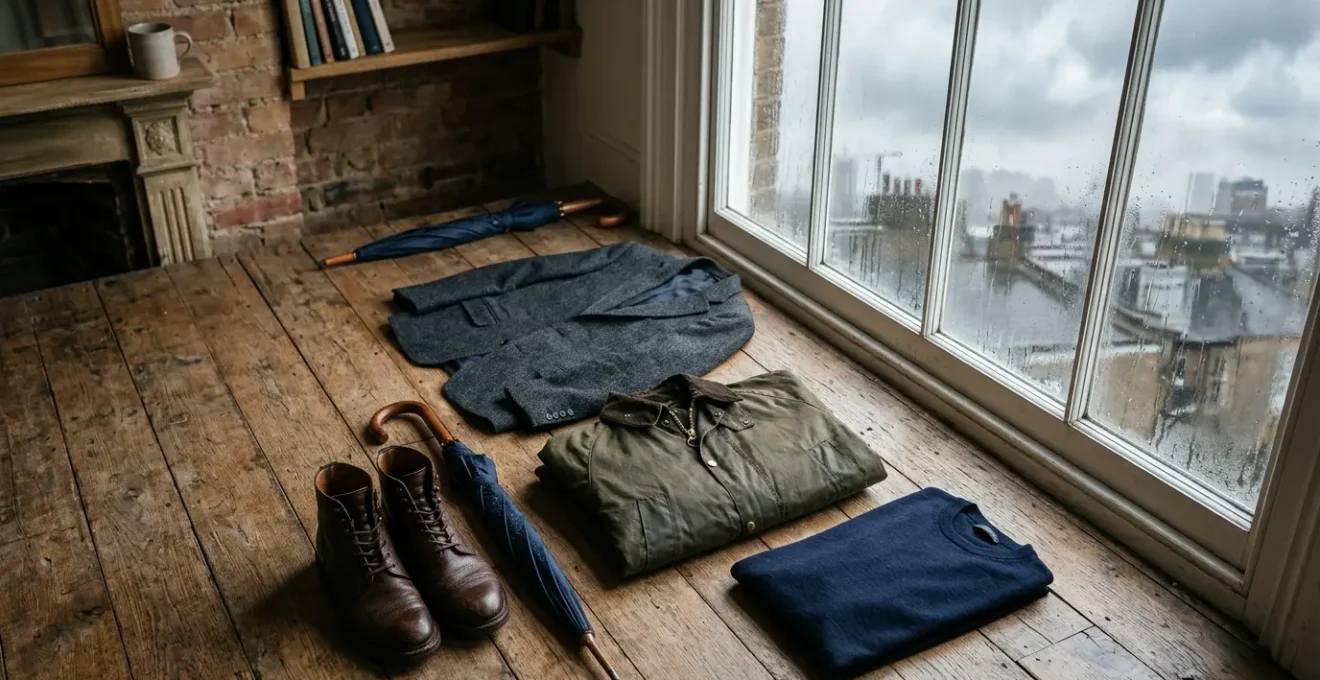
Contrary to popular advice, a truly effective British capsule wardrobe has less to do with colour palettes and more to do with fabric engineering.
- It’s about choosing materials with the right performance metrics (like GSM and waterproof ratings).
- It prioritizes durability and weather-resistance over fleeting trends.
Recommendation: Start by auditing the technical specifications of your clothes, not just their style.
The classic British style predicament: you leave the house under a hopeful sun and are met with a sudden downpour by lunchtime. For many men, the solution seems to lie in a wardrobe of “versatile” navy, grey, and beige items. We’re told to buy timeless pieces and focus on layering. Yet, despite following this advice, you still end up with a ‘waterproof’ jacket that soaks through, a jumper that makes you overheat on the Tube, and socks that are mysteriously damp by 4 PM. This approach tackles the aesthetic but ignores the fundamental problem.
The common wisdom about building a capsule wardrobe often fails in the UK because it prioritises colour coordination over material performance. It assumes all cotton t-shirts are equal and that any trench coat will fend off persistent drizzle. This is a critical oversight. The secret to a wardrobe that genuinely works in a climate of four seasons in one day isn’t about style; it’s about fabric engineering. It’s about understanding the technical specifications of your clothing as you would a piece of high-performance gear.
This guide reframes the concept. Instead of a simple styling exercise, we will treat building your capsule wardrobe as a practical engineering project. We’ll move beyond colour theory and into the world of fabric weight (GSM), fibre properties, and waterproof ratings. The goal is to build a compact, durable, and highly functional collection of garments that don’t just look good, but are purpose-built to handle the specific challenges of British weather, from damp cold to unexpected sun.
This article provides a deep dive into the material science behind a functional wardrobe. You’ll find practical, data-driven advice to help you make smarter purchasing decisions and build a collection of clothes that truly performs.
Summary: A Fabric-First Guide to a Weather-Proof Wardrobe
- Heavyweight or Lightweight: Which T-Shirt Lasts More Than 5 Washes?
- Wash or Freeze: How to Clean Raw Denim Without Ruining the Fade?
- Merino or Cashmere: Which Layer Regulates Body Heat Better?
- The Boots Mistake That Leads to Wet Socks in October
- When to Pack Away the Linen: The Temperature Drop Guide
- Why Your ‘Waterproof’ Jacket Leaks During Heavy Downpours?
- Why Fast Fashion Polyester Is Making You Sweat More Than Cotton?
- How to Build a Capsule Wardrobe with Only 10 Items for Work?
Heavyweight or Lightweight: Which T-Shirt Lasts More Than 5 Washes?
The humble t-shirt is the foundation of any capsule wardrobe, yet it’s often the first item to lose its shape, thin out, or develop tiny holes. The culprit isn’t bad luck; it’s fabric weight, measured in Grams per Square Metre (GSM). A lightweight t-shirt might feel pleasant on a rare hot day, but its low GSM (typically under 150) means it has less material, making it prone to warping and damage in the wash. For a durable, year-round wardrobe staple in the UK, a midweight (150-200 GSM) or heavyweight (200+ GSM) t-shirt is a far superior investment.
The structural integrity of a t-shirt also depends on the quality of the cotton itself. Pima cotton, for example, has longer fibers (around 1.5 to 2 inches) compared to regular cotton (around 0.75 inches). These longer fibers create a stronger, softer, and more resilient yarn that resists pilling and holds its shape. In fact, premium variants like Supima cotton boast impressive durability, with some research showing a 30% stronger tensile strength compared to standard cottons. This “fabric engineering” at the fibre level is why a premium heavyweight tee feels substantial and looks good for years, while a cheap, lightweight one becomes a rag after a few washes.
Choosing the right t-shirt is the first step in applying material intelligence to your wardrobe. A heavier, well-constructed tee provides a structured look that can be dressed up or down, and its inherent durability means you buy better, and buy less often. The following table breaks down the key differences.
| Weight Category | GSM Range | Best Use | Durability |
|---|---|---|---|
| Lightweight | Under 150 GSM | Hot weather, undershirts | Often sheer, loses shape quickly |
| Midweight | 150-200 GSM | Standard daily wear | Balance of comfort and durability |
| Heavyweight | Over 200 GSM | Premium quality, structured look | Superior longevity, resists warping |
This focus on material substance over fleeting style is the core principle of a wardrobe built to last. It ensures each piece is not just an aesthetic choice, but a functional asset.
Wash or Freeze: How to Clean Raw Denim Without Ruining the Fade?
Raw denim is a perfect capsule wardrobe component: durable, versatile, and it develops a unique character over time. However, its care is a source of intense debate. The internet is filled with myths, including the popular but ineffective advice to “freeze your jeans” to kill bacteria. In reality, a domestic freezer doesn’t get cold enough to be truly sanitising. The real challenge, especially in the UK’s damp climate, is cleaning the denim without stripping the indigo dye and ruining the high-contrast fades you’ve worked hard to earn.
The key is to avoid the washing machine for as long as possible—a minimum of six months of regular wear is a good benchmark. For minor spills, spot cleaning with a damp cloth is the best approach. When a full clean is unavoidable, the most effective method is a strategic cold soak. This involves submerging the jeans inside-out in a tub of cold water for 30-45 minutes to lock in the dye before gently agitating them. This removes grime without the harsh mechanical action of a washing machine that causes premature, uniform fading.
Drying is the most critical stage for climate-proofing your denim. Always hang them inside-out, away from direct sunlight or intense heat, which can cause ugly, uneven streaks. In a damp British home, ensuring good air circulation is vital. Aim for them to be completely dry within 24 hours to prevent the musty smell of mildew from setting in. This careful, patient process preserves the denim’s integrity and allows for the development of beautiful, personal fade patterns that tell a story.
Merino or Cashmere: Which Layer Regulates Body Heat Better?
When it comes to essential knitwear for a British capsule wardrobe, the choice often comes down to two luxury wools: merino and cashmere. While both are excellent natural fibres, they have distinct properties that make one a more practical choice for the UK’s variable climate. Cashmere is renowned for its incredible softness and warmth-to-weight ratio, but it’s delicate and can lose its shape when damp. Merino wool, on the other hand, is the superior performance fabric for a climate defined by dampness and fluctuating temperatures.
Merino wool’s magic lies in its fine, crimped fibres. These fibres can absorb up to 30% of their own weight in moisture vapour without feeling wet to the touch, wicking sweat away from your skin to keep you dry. Furthermore, merino is thermoregulating: it traps air to keep you warm in the cold, but releases heat and moisture when you get warm, preventing the clammy feeling you get with less breathable materials. This makes it the perfect layer for a day that starts with a cold commute and ends in a warm office or pub. As stylist Nick English of Stridewise notes, versatility is paramount: “A great sweater for a capsule wardrobe is midweight, warm, and not too textured — this way it’s more versatile”.
From a fabric engineering perspective, look for a sweater with a substantial weight. While a t-shirt is measured in GSM, a quality sweater’s density is also a key indicator of longevity. For instance, a high-quality French Terry loopback sweatshirt should measure between 300-400 g/m2 to provide structure and warmth. A merino knit of a similar substantial feel will offer superior performance and durability, making it a true workhorse in your wardrobe, far more resilient and practical than its more delicate cashmere cousin.
The Boots Mistake That Leads to Wet Socks in October
Come October, the British pavement becomes a minefield of puddles. This is where many men discover the critical mistake in their footwear choice: they’ve bought boots based on style, not structure. A handsome-looking leather boot may appear robust, but if its sole is merely glued on, it offers little genuine protection against the relentless damp. This is the fast-fashion approach to footwear, and it inevitably leads to the miserable feeling of wet socks by mid-afternoon.
The solution is an age-old piece of footwear engineering: the Goodyear welt. This construction method involves stitching a strip of leather (the welt) to the upper and the insole, and then stitching the outsole to that same welt. This double-stitch creates a highly water-resistant, durable, and—crucially—resoleable boot. It creates a structural barrier that is far superior to a simple cemented sole, making it an essential feature for any footwear intended to survive a British autumn and winter. The unpredictability of the weather here demands this level of flexibility and resilience in your footwear choices.
However, even the best-made boots require maintenance to perform optimally. Leather is a skin; it needs to be cleaned and conditioned to stay supple and water-resistant. Letting mud and salt dry on your boots will draw out the natural oils, leading to cracking and water ingress. A simple pre-winter conditioning routine is non-negotiable for keeping your feet dry and extending the life of your investment.
Your Essential Pre-Winter Boot Conditioning Checklist
- Clean boots thoroughly with saddle soap to remove embedded dirt and salt.
- Apply a quality leather conditioner generously, focusing on flex points and seams.
- Treat the welt seam with a specialised sealant or natural beeswax to block the primary point of water entry.
- Insert cedar shoe trees to absorb moisture and maintain the boot’s shape while it dries.
- Apply a final coat of waterproofing spray 24 hours before their first autumn wear.
This small investment of time is the difference between boots that last two seasons and boots that last a decade.
When to Pack Away the Linen: The Temperature Drop Guide
Linen is the undisputed king of summer fabrics. Its breathability and crisp texture are perfect for warm, sunny days. However, its loose weave, which is a benefit in the heat, becomes a significant liability as the temperature drops. Wearing linen in the cold is not only uncomfortable but also looks out of place. Knowing when to make the seasonal transition to warmer textiles is a key skill in managing a functional capsule wardrobe.
Rather than relying on the calendar, use the thermometer as your guide. The tipping point for linen is generally around 15°C. According to textile experts, it’s wise to transition away from pure linen when temperatures consistently drop below 15°C. At this point, the fabric offers little insulation and can feel cold and stiff against the skin. This is where your material intelligence comes into play, swapping out linen shirts for fabrics with a denser weave and better thermal properties, like chambray, flannel, or fine-gauge merino wool.
This transition isn’t an abrupt switch but a gradual process of layering and fabric rotation. Early autumn (15-20°C) is ideal for cotton-cashmere blends or layering a light knit over a cotton shirt. As the temperature falls further into late autumn (10-15°C), it’s time to bring out the flannel shirts and merino wool base layers. This strategic rotation ensures you are always dressed appropriately for the conditions, maintaining both comfort and style.
| Season | Temperature Range | Primary Fabrics | Layering Options |
|---|---|---|---|
| Summer | Above 20°C | Linen, lightweight cotton | Single layer sufficient |
| Early Autumn | 15-20°C | Cotton-cashmere blends, chambray | Light layering with knits |
| Late Autumn | 10-15°C | Flannel, merino wool | Multiple layers required |
| Winter | Below 10°C | Heavy wool, tweed | Full layering system |
By using temperature as your primary guide, you move from a reactive to a proactive approach to dressing, a hallmark of a truly well-managed wardrobe.
Why Your ‘Waterproof’ Jacket Leaks During Heavy Downpours?
There’s nothing more frustrating than a “waterproof” jacket failing you in the middle of a British downpour. The reason this happens is that “waterproof” is not a simple yes-or-no quality; it’s a measurable performance metric. This is measured by a ‘Hydrostatic Head’ (HH) test, which determines how many millimetres of water a fabric can withstand before it starts to leak. A jacket labelled ‘waterproof’ or ‘shower-resistant’ might only have a rating of 1,500mm to 5,000mm, which is fine for light drizzle but will fail under sustained or heavy rain.
The numbers matter. A jacket with a 10,000mm rating, for example, can hold back a 10-metre column of water before leaking. For typical British weather, a minimum rating of 15,000mm is recommended for reliable protection. For those who face torrential downpours or spend significant time outdoors, investing in a jacket with a rating of 20,000mm or more is a wise decision. Top-tier technical fabrics set an even higher bar; for example, most Gore-Tex fabrics achieve a hydrostatic head rating of at least 28,000mm, offering fortress-like protection.
However, a high HH rating is only half the story. The other crucial metric is breathability, measured in g/m²/24hrs. This indicates how much water vapour can pass through the fabric. A jacket can be completely waterproof but useless if it doesn’t let your sweat escape, leaving you soaked from the inside. A good balance for UK conditions is a jacket with at least 15,000mm HH and a breathability rating of 10,000 g/m²/24hrs or more. Checking these two performance metrics before buying is the only way to ensure your outerwear is an asset, not a liability.
Why Fast Fashion Polyester Is Making You Sweat More Than Cotton?
Many affordable fast-fashion items rely on polyester. It’s cheap, durable, and holds colour well. However, it has a major drawback that makes it particularly ill-suited for a functional wardrobe: it doesn’t breathe. Polyester is essentially a plastic. Its fibres are non-absorbent, meaning that when you perspire, the moisture has nowhere to go. It gets trapped against your skin, creating a clammy, uncomfortable micro-climate that makes you feel far sweatier and can quickly lead to you feeling chilled when you stop moving.
In contrast, natural fibres like cotton, linen, and wool are inherently breathable. They can absorb moisture and allow it to evaporate away from your body, regulating your temperature far more effectively. This is why a simple cotton t-shirt feels infinitely more comfortable on a humid day than a slick polyester equivalent. As the editorial team at SANVT states, the choice is clear for anyone seeking quality and comfort: “Synthetic materials are a no-no if you want high-quality and sustainable textiles. Instead, go for organic natural fibres like cotton, lyocell, linen, hemp, or bamboo”.
Synthetic materials are a no-no if you want high-quality and sustainable textiles. Instead, go for organic natural fibres like cotton, lyocell, linen, hemp, or bamboo
– SANVT Editorial Team, Fabric GSM & Weight Guide
For those seeking performance that rivals synthetics but with the breathability of natural fibres, modern semi-synthetics offer an excellent solution. Modal, a fabric derived from beech trees, is a standout performer. It has a silky texture and is often blended with cotton and spandex. This blend gives the resulting fabric a breathable, cooling edge and makes it up to 50% more resistant to shrinking than pure cotton. A modal-blend t-shirt or base layer provides superior moisture management in British humidity, making it a far more intelligent choice than pure polyester for an active or daily-wear garment.
Key Takeaways
- Prioritise Fabric Specs: A truly functional wardrobe is built on performance metrics like GSM and waterproof ratings, not just colour.
- Understand Material Performance: Different materials (Merino, Pima Cotton, Modal) solve different problems. Choose the right tool for the job.
- Maintain for Longevity: Proper care, from boot conditioning to denim soaking, is essential for extending the life of your investment pieces.
How to Build a Capsule Wardrobe with Only 10 Items for Work?
Applying the principles of fabric engineering and material intelligence culminates in the ability to build an incredibly efficient and versatile wardrobe. A 10-item work capsule is not about limitation; it’s about precision. By choosing pieces with the right materials, construction, and coordinated colours, you create a system where almost every item works with every other, eliminating decision fatigue and ensuring you are always appropriately dressed for the office and the unpredictable commute.
A simple but highly effective formula is the 3x3x3+1 British Work Capsule. This framework provides structure for a complete, interchangeable work wardrobe that can handle everything from a formal meeting to a casual Friday, all while navigating the British climate. The key is selecting items made from the performance materials we’ve discussed, such as merino wool for knitwear and quality cotton for shirts.
- 3 Uppers: A white Oxford cotton shirt (a durable, breathable staple), a light blue dress shirt, and a fine-gauge merino knit sweater (for thermoregulation).
- 3 Lowers: A pair of navy wool trousers (naturally temperature-regulating and smart), grey smart chinos, and a pair of dark indigo raw denim jeans (for smart-casual days).
- 3 Layers: A versatile navy blazer, a merino cardigan (for an extra layer of warmth), and a weather-resistant overshirt or light technical jacket.
- +1 Footwear: A pair of dark brown leather Derby shoes or Loafers with a Goodyear welt, which will match a corresponding brown leather belt.
This curated collection of just ten items provides dozens of potential combinations. The result is an end to the morning scramble to find something to wear. As Fashion Times UK aptly puts it, the benefit of this approach is transformative: “When colours are coordinated, fits are intentional, and fabrics suit the British climate, getting dressed becomes efficient and instinctive rather than stressful”.
When colours are coordinated, fits are intentional, and fabrics suit the British climate, getting dressed becomes efficient and instinctive rather than stressful
– Fashion Times UK, Transform Your Style with a Capsule Wardrobe
Begin today by evaluating one item in your closet not by its brand or style, but by its material and construction. That is the first, most important step towards building a wardrobe that truly works for you and the weather you live in.