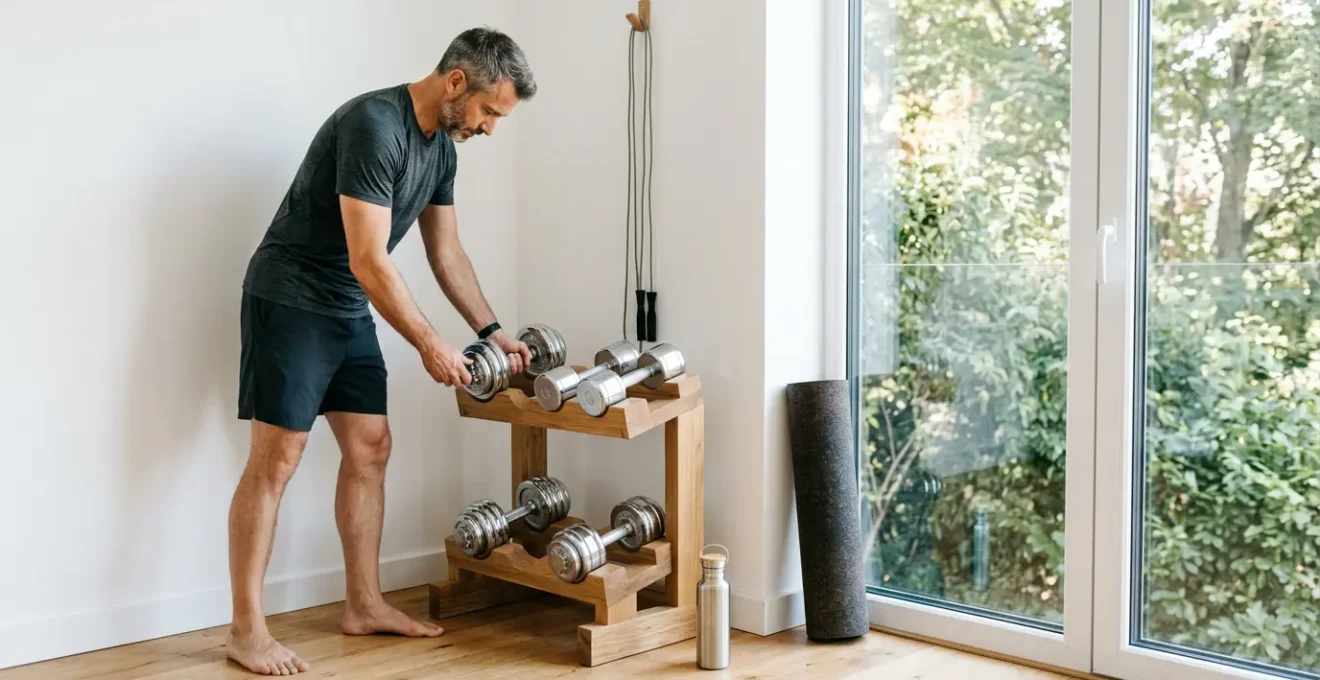
The secret to building muscle after 40 isn’t training harder; it’s training smarter by creating a powerful anabolic environment outside the gym.
- Time-efficiency is your greatest asset. Short, intense workouts at home are often more effective than long, inconsistent gym sessions.
- Physiological levers like deep sleep and stress management have a greater impact on muscle growth than an extra set or rep.
Recommendation: Shift your focus from “time spent training” to “quality of recovery.” Prioritize sleep and stress reduction, as they dictate your body’s ability to build muscle.
If you’re a man over 40, you’ve likely noticed a frustrating reality: the muscle that was once easy to maintain now seems to be quietly slipping away. This process, known as sarcopenia, can feel like an inevitable decline. The common advice is predictable: “lift heavier,” “eat more protein,” and “be consistent.” While not wrong, this advice often ignores the biggest constraint for a man in his prime: time. The thought of spending two hours a day in a crowded gym is simply not a reality when balancing a career, family, and life’s other demands.
This leads many to either give up or fall into the “weekend warrior” trap—crushing themselves on Saturday and spending the next three days in pain. But what if the entire premise was flawed? What if the key to rebuilding and gaining muscle after 40 wasn’t about adding more to your plate, but about being more strategic with the time you have? The solution lies not in brute force, but in physiological leverage. It’s about understanding and optimizing the hormonal and recovery signals your body responds to.
This guide moves beyond generic tips to provide a science-backed, efficient framework. We’ll explore how to make your workouts more effective, not longer. We’ll show you why your sleep quality is more anabolic than a post-workout shake and how managing stress is fundamental to building a stronger, more resilient body. This is your blueprint for turning the tables on age-related muscle loss, proving that your best years of strength are still ahead of you, without sacrificing your life to the gym.
To navigate this efficient approach, we’ve structured this guide to address the most pressing questions men over 40 face, from the logistics of your workout space to the biology of your recovery.
Summary: A Practical Guide to Building Muscle After 40
- Dumbbells or Membership: Which Is More Cost-Effective for Dads?
- Why Your Knees Hurt When You Squat (And How to Fix It)?
- Protein Shakes or Real Food: Which Is Better for Post-Workout Recovery?
- The ‘Weekend Warrior’ Mistake That Leads to Monday Morning Pain
- Morning or Evening: When Is Testosterone Highest for Training?
- Deep Sleep or REM: Which Metric Determines Your Energy Levels?
- When to Apply Eye Cream: Morning or Night for Best Results?
- Why ‘Man Up’ Is the Worst Advice for Depression Recovery?
Dumbbells or Membership: Which Is More Cost-Effective for Dads?
For the time-crunched man over 40, the first hurdle is logistics. The debate between a home setup and a gym membership isn’t just about money; it’s about the most valuable currency you have: time and consistency. A gym membership offers variety, but it comes with hidden costs like travel time, waiting for equipment, and the “friction” of just getting there. This friction is often the biggest killer of consistency. An initial investment in quality home equipment, like adjustable dumbbells and a bench, can eliminate these barriers entirely.
The “hybrid” model is emerging as a powerful solution. This involves handling the majority of your workouts—around 80%—at home with maximum efficiency, and using a gym or a day pass once a week for heavy compound lifts or specialized equipment you don’t own. This blend provides the convenience needed for daily consistency with the variety needed for long-term progress. It turns the “all or nothing” decision into a flexible strategy that adapts to your life.
Case Study: Anthony’s Success with the Hybrid Model
Anthony, aged 49, transformed his approach from intensive daily gym sessions to a hybrid model. He invested in adjustable dumbbells and a pull-up bar for home, using them for 80% of his workouts, then visited the gym once weekly for heavy compound lifts. The result: he gained noticeable muscle size on his legs, arms, and upper torso while training half the volume he did before. His hip tightness disappeared, and he achieved better results with less time investment.
To truly understand the cost, you must factor in your time. The following table breaks down the real investment, showing how a home setup often pays for itself not just in dollars, but in reclaimed hours.
| Factor | Home Setup (Dumbbells) | Gym Membership | Hybrid Model |
|---|---|---|---|
| Initial Investment | $300-800 (adjustable dumbbells, bench) | $0 upfront | $300 + 10-visit pass |
| Monthly Cost | $0 after purchase | $40-80/month | $20-30 (occasional passes) |
| Time Cost/Week | 0 minutes commute | 60-90 minutes commute | 15-20 minutes (1x/week) |
| Consistency Factor | 95% (no excuses) | 60-70% (weather, time dependent) | 85% (flexible) |
| Equipment Variety | Limited | Extensive | Good balance |
Ultimately, the most cost-effective option is the one you will use consistently. For most busy dads, eliminating the commute and friction of a gym makes a home or hybrid setup the clear winner for long-term results.
Why Your Knees Hurt When You Squat (And How to Fix It)?
The squat is hailed as the king of exercises, but for many men over 40, it’s the king of pain. If your knees ache during or after squats, you are not alone. Research from fitness professionals shows that 40% of lifters over 40 experience knee issues with barbell squats. The problem is rarely the squat itself, but rather a combination of two factors: decades of sitting that have led to dormant glutes and tight hip flexors, and a “knees-first” movement pattern. When your glutes don’t fire properly, your quadriceps and knee joints take on a load they weren’t designed to handle, leading to inflammation and pain.
The fix isn’t to stop squatting, but to re-engineer the movement. The first step is activation. A short pre-workout routine to “wake up” your glutes and release your hips can dramatically change how you squat. The second step is to shift your focus from bilateral (two-legged) squats to unilateral (single-leg) variations. Exercises like the Bulgarian split squat, shown below, reduce the compressive load on your spine, force your glutes to stabilize, and build functional, real-world strength without compromising your knees.
As you can see, this movement promotes a healthy forward knee track while demanding balance and glute engagement. It’s a safer, and often more effective, way to build powerful legs. By dedicating just five minutes to activation before your workout, you can transform the squat from a source of pain into a powerful tool for muscle growth.
Your 5-Minute Pre-Squat Activation Plan
- Glute bridges: 2 sets of 15 reps to activate dormant glutes
- 90/90 hip stretch: 30 seconds each side to release hip flexors
- Couch stretch: 60 seconds per leg for hip flexor mobility
- Bodyweight box squats: 10 reps to groove the pattern
- Calf raises: 15 reps to activate lower leg stability
Stop forcing movements that cause pain. Instead, listen to your body and choose smarter variations that build you up without breaking you down. Your joints will thank you for it.
Protein Shakes or Real Food: Which Is Better for Post-Workout Recovery?
The fitness industry has conditioned us to believe that chugging a protein shake within a 30-minute “anabolic window” post-workout is essential for muscle growth. For busy men, this often means prioritizing a shake over a real meal. However, the science points to a more nuanced reality. For men over 40, the immediate timing of protein is far less important than the total amount consumed throughout the day. In fact, total daily protein intake matters 3x more than timing for optimizing muscle protein synthesis.
This doesn’t mean shakes are useless; it means their role should be strategic. A shake is a tool for convenience and supplementation, not a replacement for the rich micronutrients and satiety provided by whole foods like chicken, beef, eggs, or Greek yogurt. The ideal approach isn’t “shakes OR food,” but “shakes AND food.” Using a shake as a “bridge” is a highly effective strategy for the man on the go.
The Strategic Bridge Approach
A 2024 case study of men over 40 found that using protein shakes as a ‘bridge’ between the gym and a whole food meal optimized recovery. Participants consumed a shake immediately post-workout during their commute, then ate a comprehensive, whole-food meal 60-90 minutes later. This approach resulted in better adherence to protein targets (hitting a goal of 0.8-1g per pound of bodyweight) compared to either shakes-only or food-only approaches.
Your goal should be to hit your daily protein target consistently. For muscle gain, a good starting point is 0.8 to 1.0 grams of protein per pound of your target body weight. Use shakes to fill the gaps—when you’re in a rush, during your commute, or to top up your daily total—but prioritize nutrient-dense, real food as the foundation of your recovery.
Don’t stress about the anabolic window. Focus on total daily protein, and use shakes as the convenient tool they are, not as a magic bullet.
The ‘Weekend Warrior’ Mistake That Leads to Monday Morning Pain
It’s a familiar pattern for many busy men: five days of relative inactivity at a desk, followed by a heroic, high-volume workout on Saturday to “make up for it.” The result? Extreme soreness that lasts until Wednesday, sabotaging any chance of a mid-week workout and reinforcing a boom-bust cycle. This “weekend warrior” approach is not only inefficient for muscle growth, but it also increases the risk of injury. Your body isn’t designed for sudden shocks; it thrives on consistent signals.
The antidote to this is a concept called “movement snacking.” Instead of one massive session, you sprinkle small, manageable bouts of activity throughout your day and week. This doesn’t mean doing a full workout at the office. It means breaking up long periods of sitting with simple, low-intensity movements. A few bodyweight squats, a short walk, or some mobility exercises can keep your muscles active, improve blood flow, and prime your body for more intense workouts.
This approach keeps your metabolism humming and tells your body that it needs to stay ready and strong. It turns sedentary time into an opportunity for low-level recovery and activation. As one individual found, the results can be transformative.
I was the classic weekend warrior, destroying myself on Saturdays and hurting until Wednesday. I started doing just 10 minutes of movement daily – simple bodyweight exercises during work breaks. After 8 weeks, I lost 100 pounds and got twice as strong on several lifts. The key wasn’t harder weekends, but consistent daily movement.
– 60-Year-Old Trainee
By shifting your mindset from “annihilation” to “accumulation,” you create a sustainable practice that builds momentum. You arrive at your weekend workout prepared and strong, not stiff and cold. This leads to better performance, faster recovery, and, ultimately, more muscle.
Your goal isn’t to destroy your body once a week. It’s to build it, consistently, day by day. A little movement every day is infinitely more powerful than a lot of movement once in a while.
Morning or Evening: When Is Testosterone Highest for Training?
The conventional wisdom for men has long been to train in the morning to take advantage of naturally higher testosterone levels. While it’s true that testosterone peaks in the early hours, this is an oversimplified view that ignores the other side of the hormonal coin: cortisol, the stress hormone. For a busy professional, morning often means a rush of emails, family duties, and mental stress. Training in this high-cortisol state can be counterproductive.
Interestingly, the key metric for an anabolic (muscle-building) state isn’t just high testosterone, but a favorable testosterone-to-cortisol ratio. Evening workouts, when cortisol levels are naturally lower after the day’s peak, can offer a significant advantage here. One study on hormone patterns found that for busy professionals, evening workouts show a 15% better testosterone-to-cortisol ratio. This suggests that even if testosterone is slightly lower, the overall hormonal environment may be more conducive to growth and recovery.
However, the most important factor is personal chronobiology—your unique internal body clock. As leading experts point out, the theoretical best time means nothing if you’re not mentally and physically ready to perform. The quality of your workout, your ability to focus, and the intensity you can generate are what truly drive results.
Listen to your body. Do you feel stronger and more focused after shedding the day’s stress in the evening? Or does a morning session energize you for the day ahead? Track your performance and energy levels. The “best” time to train is not dictated by a generic chart, but by when you can consistently deliver your best effort.
Forget the dogma. The optimal time to train is when you feel your strongest, most focused, and most capable of having a high-quality session. That is your personal anabolic window.
Deep Sleep or REM: Which Metric Determines Your Energy Levels?
You can have the perfect workout plan and a flawless diet, but if your sleep is poor, you will not build muscle effectively. For men over 40, sleep is not a passive activity; it is your most powerful anabolic state. While all sleep stages are important, one stands out for physical repair and growth: deep sleep. This is the stage where your body does its heavy lifting for recovery. While REM sleep is crucial for cognitive function and memory, deep sleep is when your body releases the majority of its daily Human Growth Hormone (HGH).
HGH is a potent hormone that facilitates tissue repair, bone strengthening, and muscle building. Sleep research demonstrates that up to 75% of daily Human Growth Hormone is released during the initial deep sleep phases. If you consistently cut your sleep short or have fragmented sleep that prevents you from entering these deep stages, you are robbing your body of its primary tool for growth. This is why you can feel physically exhausted and weak after a night of poor sleep, even if you logged 8 hours in bed.
Therefore, your goal shouldn’t just be more sleep, but more quality deep sleep. This means creating a sleep environment and pre-bed routine specifically designed to promote it. Simple changes like managing light exposure, controlling room temperature, and using strategic supplements can significantly increase the time your body spends in this critical, muscle-building state. Think of it as your nightly recovery session—it’s just as important as your time in the gym.
The Anabolic Sleep Protocol: Your Checklist for Deeper Sleep
- 90 minutes before bed: Take a hot shower or bath to help lower your core body temperature, signaling sleep.
- 60 minutes before: Consider supplementing with 200-400mg of magnesium glycinate to promote relaxation.
- 30 minutes before: Drink a small glass of tart cherry juice, a natural source of melatonin.
- Bedroom environment: Aim for a cool temperature between 65-68°F (18-20°C).
- Total darkness: Use blackout curtains or a high-quality eye mask to block all light.
Don’t just track hours slept; prioritize the habits that lead to deep, restorative sleep. It is the single most effective, and free, performance enhancer you have.
When to Apply Eye Cream: Morning or Night for Best Results?
While seemingly a world away from lifting weights, how you care for your skin, particularly around the eyes, sends a powerful signal about your overall state of recovery and vitality. For an active man over 40, fatigue from training, stress, and poor sleep often shows up first as dark circles and puffiness. An eye cream isn’t a vanity product; it’s a recovery tool for your face. But applying it randomly is like eating your protein at the wrong time—you miss the strategic benefit.
The key is to adopt a two-pronged strategy: defense in the morning and repair at night. A morning application should focus on protection and de-puffing. Ingredients like caffeine constrict blood vessels to reduce puffiness, while Vitamin C and SPF protect the delicate skin from environmental damage you might encounter during a run or outdoor activity. In contrast, a night application is all about repair. This is when you use powerhouse ingredients like retinol, peptides, and hyaluronic acid. These work in synergy with your body’s natural overnight repair processes, especially the HGH release during deep sleep, to rebuild collagen and hydrate the skin.
There’s also a third, often overlooked opportunity: post-workout. An intense training session can leave you looking drained. Applying a cooling eye gel immediately after your workout, alongside your protein shake, can combat inflammation and instantly refresh your appearance. This simple habit reframes skincare as an integral part of your overall recovery ritual.
This table outlines a simple strategy to get the most out of your product, aligning your skincare with your active lifestyle.
| Timing | Primary Function | Key Ingredients | Benefits for Active Men |
|---|---|---|---|
| Morning (AM) | Defense | Caffeine, Vitamin C, SPF | De-puffs after sleep, protects during outdoor workouts |
| Night (PM) | Repair | Retinol, Peptides, Hyaluronic Acid | Synergizes with HGH release during sleep |
| Post-Workout | Recovery | Cooling gels, Antioxidants | Reduces inflammation, refreshes appearance |
By aligning your skincare with your body’s natural rhythms—defense during the day, repair at night, and recovery post-workout—you turn a simple cream into a tool that helps you look as strong and energized as you feel.
Key Takeaways
- Efficiency Over Volume: Short, intense, and consistent workouts yield better results than long, sporadic ones. Focus on the minimum effective dose.
- Recovery Is Anabolic: Muscle is built outside the gym. Prioritizing deep sleep and strategic nutrition is non-negotiable for growth after 40.
- Stress Is Catabolic: Chronic stress, whether mental or physical, elevates cortisol and actively prevents muscle growth. Managing it is as important as lifting weights.
Why ‘Man Up’ Is the Worst Advice for Depression Recovery?
For generations, the default male response to struggle, stress, or depression has been to “man up”—suppress it, ignore it, and push through. In the context of building muscle, this advice is not just psychologically damaging; it is physiologically catastrophic. Your mental state is not separate from your physical body. When you’re dealing with chronic stress or depression, your body is flooded with the catabolic (muscle-destroying) hormone cortisol. Trying to build muscle in this state is like trying to build a house during an earthquake.
The science is clear: chronically elevated cortisol wages war on your anabolic goals. Endocrine research reveals that it can reduce testosterone production by up to 40% in men. This means that no matter how hard you train or how perfectly you eat, your primary muscle-building hormone is being actively suppressed. Pushing harder in the gym only adds more physical stress to the mental load, digging you deeper into a catabolic hole.
The brain is the body’s CEO. If the CEO is overwhelmed with stress and depression, it can’t effectively direct resources to growth projects like building new muscle tissue. It defaults to survival mode, which is catabolic.
– Dr. Anthony Balduzzi, Fit Father Project Research
The solution is to reframe your training. Instead of viewing workouts as another performance test to pass, see them as a tool for decompression. The goal isn’t to crush a personal record every session; it’s to process the day’s stress, move your body, and shift your hormonal state from stressed to resilient. When men make this shift, they paradoxically get stronger. Their recovery improves, sleep deepens, and their bodies finally get the signal that it’s safe to grow.
True strength isn’t about ignoring your struggles; it’s about addressing them. Your path to building a stronger body begins with building a more resilient mind. Start by treating your workouts not as a chore, but as the most powerful stress-management practice you have.